

Your Agency Moved. Did Your Compliance Records Move With It?
CIPC’s new geolocation functionality makes accurate business addresses more than an administrative detail
A change of office address can look deceptively simple.
The agency moves. The website is updated. The email footer changes. A new sign goes up outside the building.
But what happened to the company’s regulatory records?
On 6 October 2026, the Companies and Intellectual Property Commission (CIPC) announced the introduction of geolocation functionality for company and close corporation address changes through its CoR21.1 and CK2 services.
The change is designed to improve the accuracy, standardisation and traceability of the physical addresses held on the CIPC register. Rather than relying only on a typed address, the system now links the registered physical address to a real geographic location.
For estate agencies, this deserves more attention than a routine CIPC system update.
Because an agency’s address can appear across multiple regulatory, operational and client-facing systems.
And if those records do not agree, what appears to be a small administrative difference may reveal a much wider control gap.
What has CIPC changed?
Under the new functionality, when a company or close corporation submits an address change, the system uses the first line of the address to identify and populate standardised address information.
CIPC says the information generated by the geolocation functionality cannot simply be manually overwritten. The intention is to connect the registered address to the actual physical location of the company or close corporation.
CIPC has acknowledged that geographic boundaries, town names and postal codes can change over time and may differ between organisations. Minor differences in how a locality is labelled may therefore occur.
The important point is that the business must be capable of being geographically located or “pinned” to its real-world location.
CIPC also refers to the physical address, in this context, as the place where the majority of the business’s administrative functions are conducted.
This is a significant shift in emphasis.
The question is becoming less:
“What address did we type into the form?”
and more:
“Where does this business actually operate?”
CIPC had already warned businesses about outdated addresses
The geolocation change does not arrive in isolation.
In September 2026, CIPC separately warned companies about businesses that had relocated but failed to update their registered office and physical-address information.
CIPC highlighted the practical consequences: legal documents, regulatory correspondence, compliance notices and other official communications can continue being delivered to an old address.
It reminded companies that maintaining accurate registered information is a Companies Act compliance responsibility and that directors and prescribed officers are responsible for ensuring company information remains current.
That is important for every company.
For an estate agency, however, there is another layer.
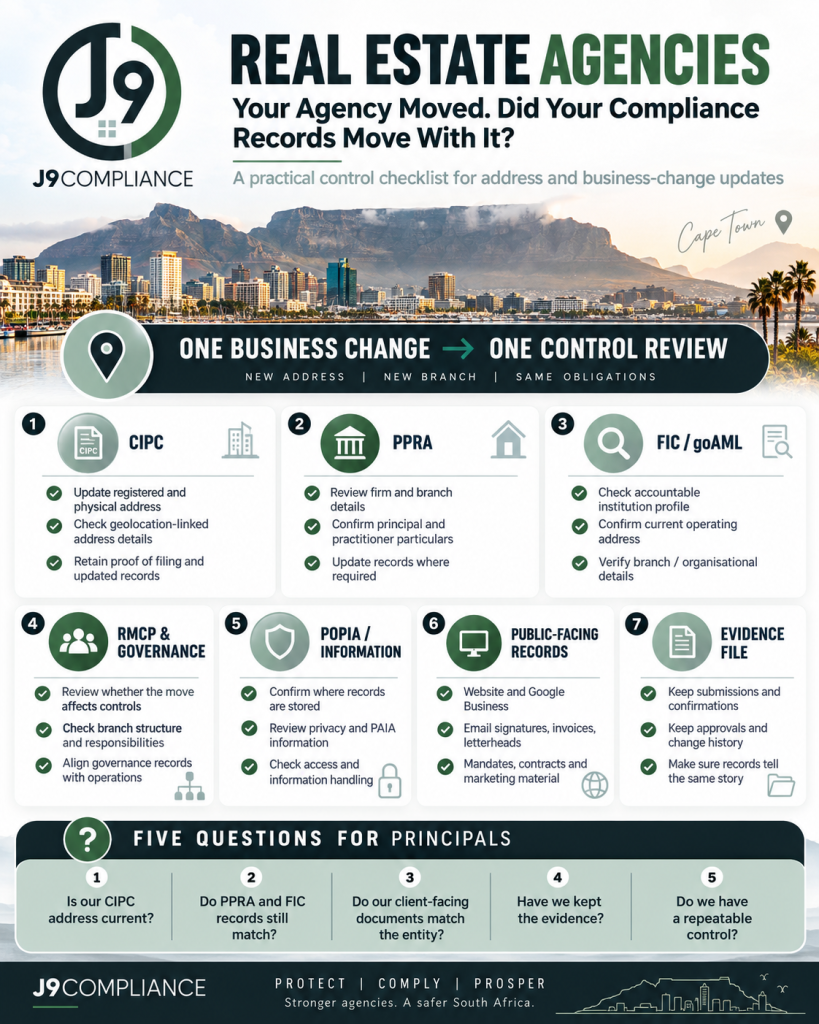
An estate agency does not have only one regulatory identity
A property business may have information recorded across a number of systems and documents, including:
CIPC;
the PPRA;
the Financial Intelligence Centre and goAML;
SARS;
banking and trust-account records;
professional-indemnity or other insurance;
contracts and mandates;
invoices and letterheads;
the agency website;
privacy notices and PAIA documentation;
landlord or lease records;
internal policies and the RMCP; and
practitioner and branch records.
Not every system will necessarily use exactly the same form of address.
But they should tell a coherent story about the same legal entity and operating business.
That is the control question.
Moving office should trigger a compliance event
One of the weaknesses we often see in compliance programmes is that documents are treated individually.
The CIPC record belongs to the accountant.
The PPRA registration belongs to administration.
FICA belongs to the compliance officer.
POPIA belongs to somebody else.
The website belongs to marketing.
The lease belongs to finance.
And nobody owns the question:
“When this business changes, which records and controls also need to change?”
That is the difference between document compliance and operating compliance.
A mature compliance system should recognise a material business change and trigger a controlled review.
An office move is one of those changes.
A simple address-change control for estate agencies
When an estate agency relocates, changes its registered office, adds a branch or restructures how the business operates, the principal should be able to initiate a single review across the relevant records.
A practical control could look like this:
1. Confirm the legal entity
Start with the basics.
What is the exact registered company or close corporation name?
What is its registration number?
Is the address being changed for the correct legal entity?
This becomes particularly important where a brand operates through more than one company, franchise entity or regional business.
2. Update and retain the CIPC evidence
Where a CIPC address amendment is required, complete the applicable process and retain evidence of:
the previous address;
the new address;
the effective date;
the submission;
supporting documents; and
the updated CIPC record.
For company address changes through CoR21.1, CIPC’s current service information notes that the change becomes effective subject to the statutory process and a minimum five-working-day period from filing.
Do not treat confirmation of the filing as disposable administration.
It forms part of the agency’s governance evidence.
3. Check the PPRA record
Ask whether the move affects any particulars held by the Property Practitioners Regulatory Authority.
This may include the firm, branches, practitioners or information associated with the agency’s regulatory registration.
Do not assume that updating one regulator automatically updates another.
4. Check the FIC/goAML registration
Estate agencies are accountable institutions under FICA.
The business should therefore check whether the address or operating-location change affects information held in its FIC/goAML registration and whether any associated branch or organisational information requires attention.
This becomes even more relevant where an agency has multiple offices or operates through a group structure.
5. Review the RMCP
An office move may sound unrelated to an agency’s Risk Management and Compliance Programme.
It is not necessarily unrelated.
Ask whether the move changes:
the geographic areas in which the agency operates;
branch structures;
client profiles;
staff responsibilities;
record storage;
access to confidential information;
cash or payment processes;
reporting lines; or
the agency’s assessed money-laundering and terrorist-financing risks.
If the underlying operating environment has changed materially, the RMCP should at least be considered as part of the review.
6. Check POPIA and information governance
Where are physical records now stored?
Who has access to them?
Did files move between premises?
Has the agency’s privacy notice or PAIA information become inaccurate?
Are old documents still being delivered to the previous office?
Does the agency’s Information Officer information remain correct?
A relocation is also an information-governance event.
7. Reconcile the public-facing business
Finally, check what clients, practitioners and third parties see.
That includes:
website contact information;
Google Business details;
email signatures;
letterheads;
invoices;
mandates;
disclosures;
marketing material;
contracts;
signage; and
standard correspondence.
The goal is simple:
The business the regulator sees should be recognisable as the same business the client sees.
Why this matters beyond the address itself
The real compliance issue is not whether one line of an address contains a slightly different suburb or postal description.
It is whether the agency has a reliable process for keeping regulatory information accurate when the business changes.
Consider the questions a principal should be able to answer:
Which legal entity operates from this office?
Is that entity correctly recorded at CIPC?
Does the PPRA information still reflect the operating structure?
Does the agency’s FIC registration correspond with its current business?
Are the correct offices, branches and practitioners associated with the right entity?
Can we produce evidence showing when the change was made and who approved it?
If the answer requires searching through emails, asking three different people and hoping somebody updated the regulator, the issue is bigger than an address.
It is a control problem.
A useful compliance principle: one change, multiple checks
No business wants to maintain the same information manually in ten different places.
But until regulatory systems are fully integrated, businesses need a reliable internal mechanism for managing changes.
For estate agencies, a useful principle is:
ONE BUSINESS CHANGE → ONE CONTROL REVIEW
A change in:
ownership;
directors;
beneficial ownership;
principal;
office address;
branch structure;
legal entity;
banking;
services;
practitioners; or
operating model
should trigger a predefined checklist of systems, documents and regulators that may be affected.
That is much safer than waiting for each regulator, auditor, bank, attorney or client to discover an inconsistency independently.
CIPC’s geolocation change is part of a wider direction
CIPC’s new functionality should not be viewed as an isolated technical enhancement.
The Commission has explicitly said the change is intended to improve the accuracy, standardisation and traceability of information in its registers and has linked better data quality with strengthened compliance and enforcement capability.
That direction matters.
Regulatory information is becoming increasingly structured, connected and capable of being checked against other information.
For property businesses, the practical response should not be fear.
It should be better control over the information that defines the agency.
Five questions for principals
If your agency has moved, restructured or changed any part of its operating footprint, ask:
1. Is our current physical address correctly recorded at CIPC?
2. Do our PPRA, FIC and other regulatory records still describe the same operating business?
3. Do our website, contracts, mandates, invoices and compliance documents use the correct entity and address?
4. Have we retained evidence of the changes and approvals?
5. Do we have a control that ensures all affected records are reviewed the next time something changes?
If you cannot answer those five questions confidently, there may be a useful compliance review to perform.
Compliance is not a collection of forms
A company address is a small piece of information.
But it sits inside a much larger control environment.
That is why J9Compliance focuses on operating compliance: connecting the entity, people, regulatory obligations, evidence and controls rather than treating each form or policy as a separate exercise.
A stronger agency is one in which the records tell the same story.
CIPC → PPRA → FICA → Governance → Evidence
When the business changes, the compliance environment should change with it.
J9Compliance
Protect | Comply | Prosper
If you are unsure whether your agency’s regulatory records, RMCP and operating controls still reflect the business as it operates today, J9Compliance can help identify the gaps and define the next actions.
J9Compliance | Protect. Comply. Prosper.
This article provides general compliance information and does not constitute legal advice, PPRA certification or a regulatory determination. Agencies and practitioners should confirm the application of the PPRA requirements to their individual circumstances.
Get Your Compliance Sorted
The recent sanctions are not isolated incidents – they represent an enforcement programme that is rapidly expanding. Being FICA compliant requires an operational, fully documented programme that your staff understands and applies daily.
If your agency’s Risk Management and Compliance Programme isn’t up to standard, don’t wait for the FIC to find the gaps.