
The Sanctions List Changed Again: What Estate Agencies Need to Know About TFS Screening
On 7 October 2026, the Financial Intelligence Centre published a new Targeted Financial Sanctions notice – TFS-924.
The update followed a decision by the United Nations Security Council’s 1518 Sanctions Committee on 5 October 2026 to remove LOGARCHEO S.A. from its sanctions list. The FIC’s South African TFS portal now records TFS-924 as its latest published notice.
At first glance, the removal of one entity from an international sanctions list may seem remote from the day-to-day operation of a South African estate agency.
It is not.
The important lesson is not the particular entity that was removed.
It is that the list changed.
And when the list changes, an accountable institution’s screening control must be capable of responding.
Targeted Financial Sanctions are not a once-off onboarding check
Estate agencies conducting estate-agency activities are accountable institutions under the FIC Act.
Among their obligations is the requirement to ensure that they do not deal with persons or entities subject to applicable targeted financial sanctions.
The FIC’s guidance makes the operational requirement particularly clear.
Accountable institutions must scrutinise client information:
when onboarding a client;
when conducting transactions; and
when the Targeted Financial Sanctions list is updated.
The FIC goes further and states that existing information concerning clients must be scrutinised against the TFS lists when the list changes.
That means a screening result obtained when a client first entered the agency’s database may not be sufficient indefinitely.
The underlying regulatory information is not static.
A live list requires a live control
The FIC’s TFS portal currently allows institutions to search individuals and entities, download the current sanctions list and subscribe to TFS notices.
The recent sequence of notices illustrates how frequently the underlying information can move.
Before TFS-924 on 7 October, the FIC published TFS-923 on 29 September and several further notices during September and August.
The compliance question for an estate agency therefore becomes:
What happens inside our business when that list changes?
Someone needs to know that an update has occurred.
The relevant client information needs to be screened or re-screened where required.
Possible matches need to be investigated.
False matches need to be resolved.
Actual matches require the appropriate escalation and reporting process.
And importantly:
There should be evidence that this happened.
This is where an RMCP becomes operational
An RMCP may state that the agency conducts Targeted Financial Sanctions screening.
That is an important starting point.
But an operational compliance system should go further.
It should establish:
Who is responsible for monitoring TFS changes?
Which clients and related persons are screened?
When does screening occur?
What system or process is used?
How is the result retained?
What happens if a possible match is identified?
Who decides whether it is a true or false match?
How is that decision evidenced?
Who is responsible for regulatory reporting if required?
The FIC specifically requires accountable institutions to document within their RMCP a process for dealing with a true TFS match versus a false match.
That distinction matters.
A compliance control is not simply:
“Search the person’s name.”
It is a process from screening → result → investigation → decision → escalation → evidence.
Screening the client may not be enough
Property transactions frequently involve more than the individual whose name appears on a mandate or sale agreement.
Companies, trusts, representatives, directors, trustees and beneficial owners can all form part of the relationship.
The FIC’s TFS guidance specifically says institutions should scrutinise information relating to persons or entities connected directly or indirectly to clients, where that information is available and known to the institution.
That is one reason why effective FICA compliance increasingly extends well beyond obtaining an ID document and proof of address.
The agency first needs to understand who it is actually dealing with.
Only then can screening meaningfully take place.
And a delisting matters too
Compliance systems often focus on identifying new sanctions.
But TFS lists can also change in the opposite direction.
On 5 October 2026, the UN Security Council Committee responsible for the Iraq sanctions regime removed LOGARCHEO S.A., reference IQe.200, from its list.
The FIC subsequently published TFS-924 on 7 October.
That demonstrates another important principle:
A good sanctions control should respond to changes – not simply accumulate names forever.
Where a person’s or entity’s sanctions status changes, the institution’s screening information and decision-making process should be capable of recognising the updated position.
The purpose is accurate risk management, not simply producing more alerts.
What should an estate agency be able to demonstrate?
A principal or compliance officer should be able to answer a few practical questions:
1. Who monitors FIC TFS updates?
There should be a clearly assigned responsibility.
2. When was our client base last screened?
Not just when the screening process was designed – when it actually happened.
3. Can we prove the screening took place?
The evidence should identify enough information to demonstrate the subject screened, date, result and any follow-up action.
4. What happens when we receive a possible match?
The process should not depend on somebody improvising when an alert appears.
5. Can we distinguish a false match from an actual match?
And can the reasoning behind that decision be demonstrated?
6. Does our RMCP describe what we actually do?
The documented process and the operational process should align.
This is an evidence issue as much as a screening issue
The FIC’s own TFS guidance warns accountable institutions that relying on commercially available screening software does not, by itself, remove their responsibility to comply.
The institution remains responsible for the control.
That is an important distinction for agencies using third-party FICA or screening systems.
Technology can make the control easier.
It does not transfer the accountability.
The agency should still understand:
what is being screened;
how often it is screened;
what lists are being used;
what happens when an alert occurs; and
where the evidence is retained.
A small regulatory update can reveal a much bigger compliance principle
TFS-924 concerns the removal of one entity from a sanctions list.
It does not represent a sudden new enforcement campaign against the property industry.
But it illustrates something important about modern compliance.
Regulatory data moves.
Client circumstances move.
Ownership structures move.
Risk changes.
And therefore compliance controls cannot simply be completed once and filed away.
For estate agencies, the practical objective should not be to create more bureaucracy.
It should be to create a repeatable control.
One person knows what must happen.
The process is documented.
The screening happens when required.
Exceptions are escalated.
And evidence is retained.
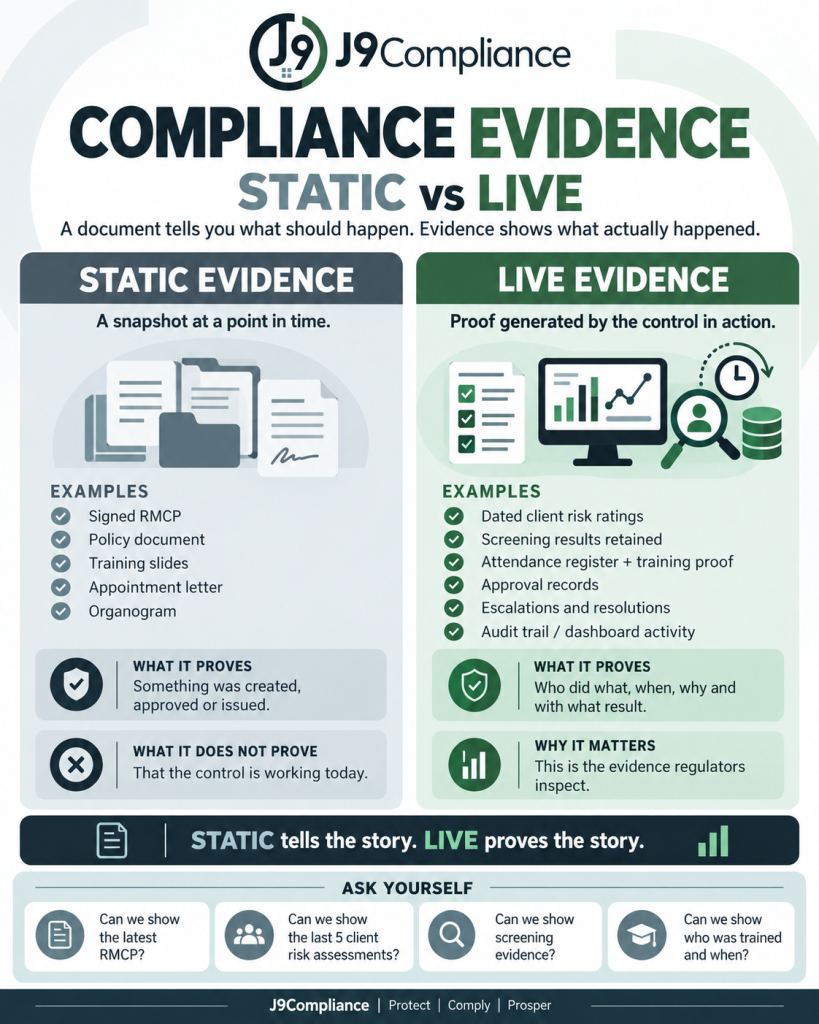
That is the difference between having a compliance requirement written into an RMCP and being able to demonstrate that the requirement is operating.
From Document Compliance to Operating Compliance
Document Compliance
“Our RMCP says we perform sanctions screening.”
Operating Compliance
“We can show when the screening took place, who was screened, what the result was and what happened next.”
The FIC’s TFS list will continue to change.
The better question for an estate agency is therefore not simply:
“Did we screen our client?”
It is:
“Do we have a control that keeps screening current – and can we prove that it works?”
That is the standard that turns compliance from a document into an operating system.
J9Compliance
Protect | Comply | Prosper
J9Compliance helps estate agencies understand their compliance pathway, identify control gaps and build practical compliance systems that can be implemented, evidenced and maintained.
This article provides general compliance information only and does not constitute legal advice. Institutions should consider the FIC Act, current FIC guidance and their own circumstances when determining their compliance obligations.
J9Compliance | Protect. Comply. Prosper.
This article provides general compliance information and does not constitute legal advice, PPRA certification or a regulatory determination. Agencies and practitioners should confirm the application of the PPRA requirements to their individual circumstances.
Get Your Compliance Sorted
The recent sanctions are not isolated incidents – they represent an enforcement programme that is rapidly expanding. Being FICA compliant requires an operational, fully documented programme that your staff understands and applies daily.
If your agency’s Risk Management and Compliance Programme isn’t up to standard, don’t wait for the FIC to find the gaps.