
Your RCR Was Due in July: If It Is Still Outstanding, Do Not Delay
Fewer than 12% of specified accountable institutions had submitted their 2026 Risk and Compliance Returns by mid-June.
It is a striking number.
But it needs context.
The figure related to the first tranche of accountable institutions whose RCR deadline was 30 June 2026. It was not an estate-agency-specific submission rate.
Estate agents fell into the second submission group.
For estate agencies, the 2026 Risk and Compliance Return was due to the Financial Intelligence Centre by:
31 July 2026 at 17:00
That deadline has passed.
So the important question for every estate agency now is very simple:
Did we submit our 2026 RCR?
If the answer is no, this is not something to leave until the RMCP deadline, the next renewal cycle or the end of the year.
It should be addressed now.
What is the RCR?
The Risk and Compliance Return — RCR — is an online regulatory questionnaire submitted to the Financial Intelligence Centre.
For estate agents, the 2026 RCR was required under Directive 11 of 2026.
It covers the agency’s understanding of its:
money-laundering risk;
terrorist-financing risk;
proliferation-financing risk; and
implementation of the risk-based controls required under the FIC Act.
For estate agencies, the return requires information covering three separate reporting years:
1 April 2023 – 31 March 2024
1 April 2024 – 31 March 2025
1 April 2025 – 31 March 2026
Those periods are reported within the same 2026 RCR.
The RCR and RMCP are not the same thing
This distinction is becoming increasingly important because estate agencies now have several separate FIC obligations occurring close together.
RCR – Risk and Compliance Return
The RCR is an online questionnaire reporting information about the agency’s risks, activities and implementation of its controls.
Estate-agent deadline: 31 July 2026
RMCP- Risk Management and Compliance Programme
The RMCP is the agency’s documented framework explaining how the business identifies, assesses, manages and monitors its FICA risks.
Under Directive 12, estate agents now also have an annual RMCP submission obligation.
2026 RMCP deadline: 31 October 2026
Completing one does not complete the other.
And if your RCR is still outstanding, the approaching RMCP deadline does not erase that non-compliance.
Why does the RCR matter?
The RCR is not simply a statistics exercise.
The FIC has explained that information contained in Risk and Compliance Returns feeds into its risk assessment and supervisory approach.
The regulator uses RCR information to help identify higher-risk accountable institutions and inform inspections.
That means the information an agency submits can become part of the regulatory picture of the business.
It also means non-submission is visible.
Historically, the FIC has already treated outstanding RCRs seriously.
In December 2024, the FIC reported 152 estate agencies penalised for failing to submit RCRs under Directive 6, representing R1.52 million in financial penalties in that enforcement process.
The FIC was equally clear about what institutions with outstanding returns should do:
Submit them.
The regulator explained that even though the original submission dates had expired, institutions should remediate their non-compliance rather than allow it to continue.
That is an important operating principle.
Missing a deadline does not make the obligation disappear.
How do estate agencies submit the 2026 RCR?
The process is electronic.
This is not a PDF that you upload to the RMCP submission area.
The RCR is completed as an online questionnaire.
The PPRA’s official June 2026 notice gives estate agencies the following submission process.
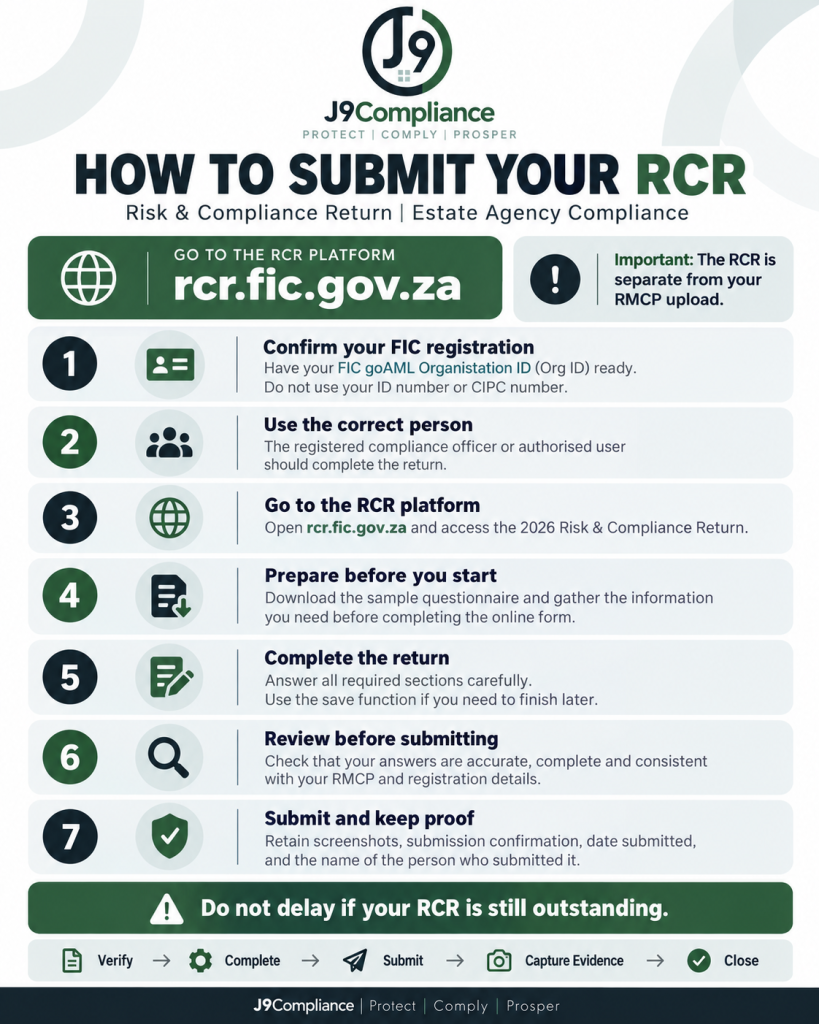
Step 1 – Confirm your FIC registration
Before you can submit the RCR, the accountable institution must be correctly registered with the FIC.
You need the agency’s FIC-issued goAML Organisation ID – Org ID.
PCC 60 makes it clear that the Org ID is a prerequisite for submission.
Do not enter:
a personal ID number;
the CIPC registration number; or
another reference number.
The RCR requires the FIC-generated Org ID.
Step 2 – Confirm the correct person will submit
The person registered with the FIC as the estate agency’s compliance officer should complete the submission on behalf of the accountable institution.
Make sure the relevant goAML user details and registration information are current before starting.
Step 3 – Go to the FIC RCR platform
Go to the FIC website and access the 2026 Risk and Compliance Return section, or use the dedicated RCR platform:
rcr.fic.gov.za
The PPRA’s guidance directs estate agencies to:
open the FIC website;
select the 2026 RCR submission section;
download the sample questionnaire;
gather the information required; and
select the submission link to enter the online system.
Step 4 – Download the questionnaire before you start
Do not try to work out the answers while clicking through the live form.
Download the sample questionnaire first.
Then gather the information required for all three reporting periods.
This is particularly important because the return asks about actual business activity and compliance implementation over several years.
Your preparation may require information relating to:
client numbers;
client risk classifications;
legal-person clients;
beneficial ownership;
PEP/PIP exposure;
transaction activity;
reporting;
TFS screening;
training;
RMCP implementation; and
internal compliance controls.
The exact questions should be taken from the current FIC questionnaire rather than guessed.
Step 5 – Make sure your answers agree with your RMCP
This is one of the most important checks.
Before submitting, ask:
Does what we say in our RCR agree with what our RMCP says we do?
For example:
If your RMCP says every client is risk-rated, your RCR should not reveal that risk assessment is not occurring.
If the RMCP says sanctions screening is performed, the business should be able to produce screening evidence.
If the RMCP identifies a particular compliance officer or governance structure, your FIC registration information should be consistent.
The objective is not to manufacture matching answers.
It is to identify inconsistencies and correct the underlying compliance process.
Step 6 – Save as you work
The FIC permits the online RCR to be saved while it is being completed.
You do not have to finish it in one sitting.
PCC 60 specifically encourages institutions to use the save functionality so that the return can be completed across several sessions if necessary.
That is particularly useful for an estate agency where information may need to be obtained from the principal, bookkeeper, compliance officer or administrative team.
Step 7 – Review everything before pressing submit
This is critical.
Once the 2026 RCR has been submitted, it cannot simply be edited and resubmitted because someone later discovers an incorrect answer.
The FIC requires institutions to review their responses for:
adequacy;
accuracy;
completeness; and
correctness
before final submission.
If an institution later discovers that incorrect information was submitted, PCC 60 provides for a written compliance query to the FIC.
So:
Review first. Submit second.
Step 8 – Submit and retain evidence
After successful submission, the system should display the questionnaire as submitted.
Do not stop there.
Retain evidence.
Your compliance file should contain, at minimum:
the Org ID used;
the date of submission;
the completed return or available submission record;
screenshots or confirmation evidence;
the person who submitted it; and
any FIC correspondence associated with the submission.
That turns:
“I think we submitted it”
into:
“Here is the evidence that it was submitted.”
What if we missed the 31 July deadline?
Do not ignore it.
And do not wait until the RMCP submission on 31 October.
The obligation is separate.
Historically, the FIC has kept RCR submission channels available after earlier deadlines and has specifically told institutions with outstanding returns to remedy the non-compliance.
For the 2026 RCR, however, an agency should confirm the current submission status directly through the FIC RCR platform.
If the system permits you to complete the outstanding 2026 RCR:
Complete it immediately.
If you cannot access the return or are uncertain how to remedy the missed deadline:
Do not leave the matter unresolved.
Contact the FIC Compliance Contact Centre or submit a compliance query through the FIC website.
PCC 60 provides the FIC Compliance Contact Centre number as:
012 641 6000 – option 1.
The appropriate approach is:
identify → remediate → retain evidence → close.
Not:
ignore → hope → wait.
A missed RCR can become more than an administrative problem
Previous FIC enforcement demonstrates why this matters.
The FIC has sanctioned institutions not simply for lacking policies but for combinations of failures involving:
outstanding RCRs;
inadequate RMCPs;
failure to implement RMCPs;
sanctions-screening failures; an
outdated registration information.
That is exactly why agencies should not think of the RCR as an isolated questionnaire.
It forms part of a broader compliance picture.
Your registration says who you are.
Your RCR says how you say you operate.
Your RMCP says how your controls should work.
Your client files show what actually happened.
Those four things should tell a consistent story.
Why the “less than 12%” statistic still matters
The webinar statistic needs to be interpreted correctly.
It did not mean that fewer than 12% of estate agencies had submitted their RCRs.
The FIC’s June warning related to the first group of specified accountable institutions approaching their earlier 30 June deadline.
But it demonstrated something bigger:
Regulators are actively measuring whether accountable institutions respond to compliance directives.
And the FIC has shown repeatedly that low submission rates lead to further communication, supervisory attention and ultimately enforcement.
For estate agencies, the relevant question today is therefore not:
“What percentage of the industry submitted?”
It is:
“Did we?”
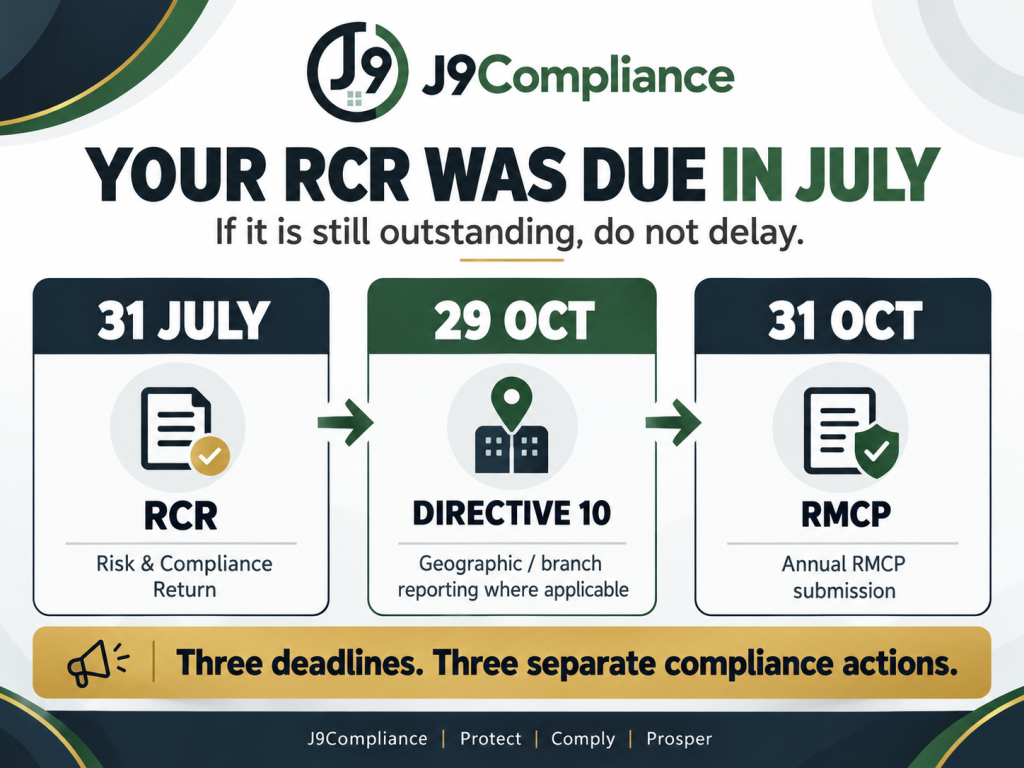
Three dates estate agencies should keep separate
As we approach the end of October, three different controls can easily become confused.
31 July 2026
2026 Risk and Compliance Return – RCR
Already due
29 October 2026
Directive 10 geographic-location reporting, where applicable
31 October 2026
Directive 12 RMCP submission
They are different obligations.
Completing one does not close the others.
Do not delay because the deadline has passed
There is a natural temptation when a deadline has already been missed to think:
“We will sort it out after the current urgent work.”
That is usually the wrong direction.
The longer a known compliance gap remains open, the harder it becomes to defend.
If your RCR is outstanding:
Check it today.
If you can submit:
Submit it.
If the system will not allow you to submit:
Log the FIC query today.
Then retain the evidence that you have taken corrective action.
Compliance is not about pretending that nothing ever goes wrong.
It is also about identifying gaps, correcting them and being able to demonstrate what was done.
The practical J9 rule
RCR outstanding?
VERIFY → COMPLETE → SUBMIT → CAPTURE EVIDENCE → CLOSE
Do not wait for 31 October.
Your RMCP submission will not close an outstanding RCR.
J9Compliance
Protect | Comply | Prosper
J9Compliance helps estate agencies understand their compliance pathway, identify regulatory gaps and build practical controls that can be implemented, evidenced and maintained.
This article provides general compliance information only and does not constitute legal advice. Agencies with an outstanding RCR should confirm the current submission/remediation process directly with the Financial Intelligence Centre.
Protect | Comply | Prosper
OUTSTANDING RCR?
RCR Submission Support — R899
J9Compliance can guide you through the outstanding RCR online, help you work through the questions and help you capture the submission evidence.
R899 once-off per legal entity • one guided online session. You remain responsible for the information supplied, you log into the FIC/goAML environment yourself, and you make the final declaration and submission.
Account access remediation, RMCP remediation, multiple entities and regulatory-enforcement responses are outside this service and are scoped separately where required.
If your agency’s Risk Management and Compliance Programme isn’t up to standard, don’t wait for the FIC to find the gaps.