

What the FIC’s Latest Inspection Data Tells Estate Agencies About Compliance
From RMCP documents to operating evidence
The Financial Intelligence Centre’s latest annual reporting gives South African estate agencies something useful: a clearer picture of how regulatory supervision is actually working.
Not speculation.
Not rumours about thousands of inspectors.
Actual inspection, review and enforcement activity.
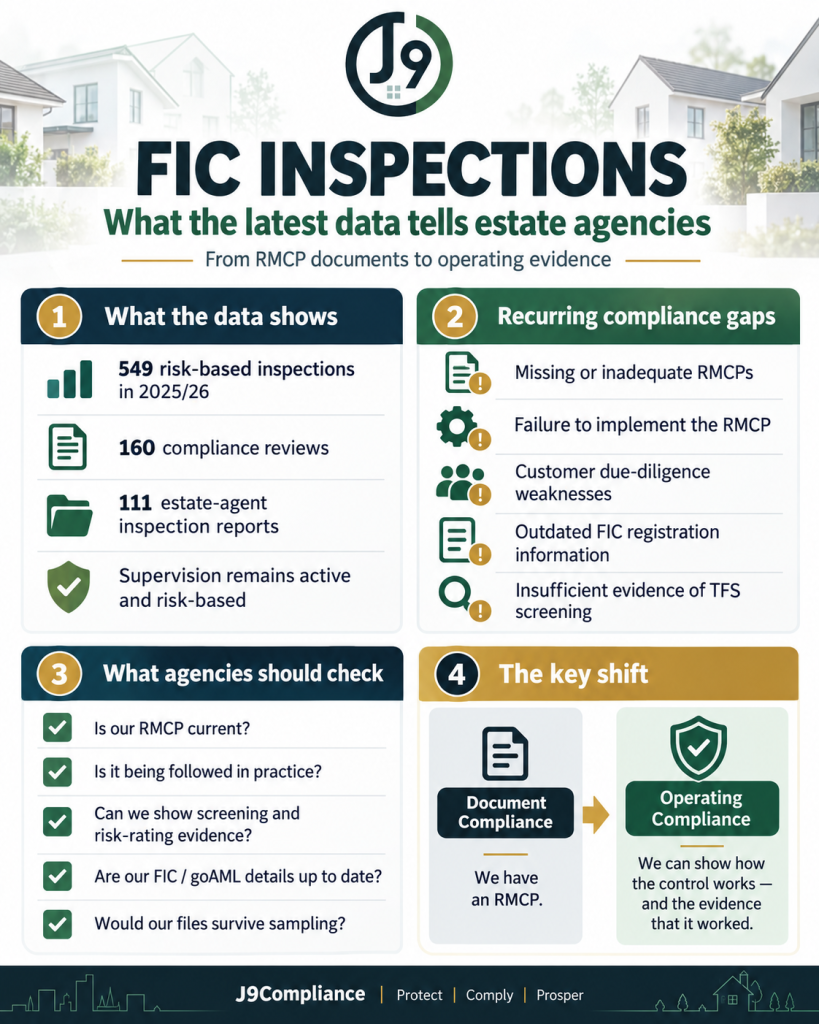
The FIC’s 2025/26 reporting records 549 risk-based inspections across the accountable institutions it supervises, together with 160 compliance reviews.
Estate agents were among the sectors receiving significant attention.
Industry analysis of the FIC report records 111 inspection reports relating to estate agents, behind legal practitioners at 169 and ahead of credit providers at 76.
The important lesson is not that every estate agency is about to be inspected.
It is that supervision is active, increasingly risk-based and focused on whether compliance controls actually work.
Risk-based supervision changes the compliance conversation
The FIC describes a supervision model in which higher-risk institutions are identified using information supplied by accountable institutions themselves.
That information can then inform inspection and review activity.
For estate agencies, this is an important shift.
Compliance is not simply about possessing the right documents.
The regulator is increasingly able to consider information about an institution’s:
risks;
controls;
regulatory submissions;
customer due diligence;
reporting;
registration status; and
implementation of its Risk Management and Compliance Programme.
The question therefore becomes less:
“Do we have the document?”
and increasingly:
“Can we demonstrate that the control described in the document is actually operating?”
Estate-agent inspections are not theoretical
The estate-agency sector has already been subject to material FIC inspection activity.
In 2024/25, the FIC conducted 165 inspections involving estate agents. In 2025/26, industry analysis of the latest FIC Annual Report records 111 estate-agent inspection reports.
That represents a decrease in the number of estate-agent inspections year on year.
It would therefore be inaccurate to claim that inspection volumes are simply rising every year.
But the more important point remains:
Estate agents continue to form a significant part of the FIC’s supervisory programme.
That means FICA compliance within property businesses should be treated as an operating responsibility, rather than an annual administrative exercise.
What are inspectors finding?
The findings reported by the FIC are particularly useful because they show where compliance programmes tend to fail.
Recurring shortcomings include:
institutions with no RMCP;
inadequate RMCPs;
failure to implement the RMCP;
failure to provide the RMCP when requested;
customer due-diligence shortcomings;
weaknesses involving legal entities and politically exposed persons;
outdated FIC registration information; and
insufficient documented evidence of Targeted Financial Sanctions screening.
That list deserves careful attention.
None of those problems is solved simply by downloading another template.
They are operating-control issues.
An RMCP is only the beginning
An RMCP describes how the institution intends to comply with the FIC Act.
But there is an important difference between:
having a control, and
being able to demonstrate that the control operated.
For example:
Your RMCP may state that every client receives a risk rating.
Can you produce the last five completed risk assessments?
Your RMCP may require sanctions screening.
Can you show who was screened, when, against what source and what the result was?
Your RMCP may require enhanced due diligence for higher-risk clients.
Can the client file demonstrate what additional measures were taken?
Your RMCP may require staff training.
Can you show who attended, when the training occurred and what was covered?
Your RMCP may assign responsibility to a compliance officer or principal.
Can you demonstrate that oversight actually occurred?
That is the difference between document compliance and operating compliance.
The regulator is also looking at whether institutions keep their information current
The FIC’s inspection findings include failures involving late registration and failures to update registration information.
This is particularly relevant now.
Estate agencies are dealing with multiple FIC obligations that require accurate information about the institution itself, including:
goAML registration details;
compliance-officer information;
branch and geographic-location information;
Risk and Compliance Returns;
RMCP submissions; and
ongoing regulatory reporting.
A compliance file prepared several years ago cannot automatically be assumed to describe the business that exists today.
Companies change.
Staff change.
Branches open and close.
Ownership changes.
Transaction patterns change.
Regulatory requirements change.
The compliance system has to keep up.
Sanctions screening provides a good example
The FIC’s inspections identified insufficient documented evidence that clients had been screened against the Targeted Financial Sanctions list.
The word documented matters.
It is possible for an agency to say:
“We screened the client.”
But an inspection may require something more useful:
Who was screened?
When?
Against which list?
What was the result?
Was there a possible match?
How was it resolved?
Where is the evidence?
This is why compliance evidence should be produced by the control itself.
The evidence should exist because the work was performed – not because somebody tried to recreate it when the regulator asked.
Enforcement is also measurable
The latest FIC reporting records approximately 60,072 registered accountable institutions, up from 55,262 the previous year – an increase of about 8.7%.
That figure covers the full FIC-regulated population and should not be confused with the number of registered property practitioners.
But it illustrates something important.
More institutions are entering a digitally visible regulatory environment.
At the same time, inspection, review, reporting and enforcement mechanisms are becoming increasingly structured.
This is not an argument for panic.
It is an argument for better systems.
What should an estate agency do now?
A sensible compliance review does not need to begin with hundreds of documents.
Start with a few practical questions.
1. Is our RMCP current?
Does it describe the business as it operates today?
2. Is it implemented?
Do staff actually follow the procedures it contains?
3. Can we produce evidence?
Can the agency demonstrate client risk assessments, screening, enhanced due diligence, approvals, training and escalation decisions?
4. Are our FIC details current?
Do our goAML registration, responsible-person details and operating structure accurately reflect the organisation?
5. Do our regulatory submissions agree with our compliance system?
What the agency says in an RCR, what its RMCP says, and what the client files demonstrate should not contradict one another.
6. Could we survive file sampling?
If five client files were selected today, would they show consistent application of the agency’s controls?
That may be the most useful question of all.
Compliance is becoming more evidence-driven
The FIC’s latest figures do not show an uncontrolled explosion in inspections.
They show something more useful.
South Africa’s anti-financial-crime supervision is increasingly risk-based, structured and evidence-driven.
For estate agencies, that means the quality of the compliance system matters.
A signed RMCP is important.
A submitted return is important.
A completed screening check is important.
But each forms part of a broader operating system.
The agency should be able to show:
what the control requires;
who is responsible;
what was done;
when it was done;
what the result was;
and
what evidence was retained.
That is how compliance becomes defensible.
Document Compliance
“We have an RMCP.”
Operating Compliance
“We can show you how the control works – and the evidence that it worked.”
That is the direction reflected in the FIC’s own inspection activity.
And it is the direction estate agencies should be preparing for.
J9Compliance
Protect | Comply | Prosper
J9Compliance | Protect. Comply. Prosper.
This article provides general compliance information and does not constitute legal advice, PPRA certification or a regulatory determination. Agencies and practitioners should confirm the application of the PPRA requirements to their individual circumstances.
Get Your Compliance Sorted
The recent sanctions are not isolated incidents – they represent an enforcement programme that is rapidly expanding. Being FICA compliant requires an operational, fully documented programme that your staff understands and applies daily.
If your agency’s Risk Management and Compliance Programme isn’t up to standard, don’t wait for the FIC to find the gaps.