
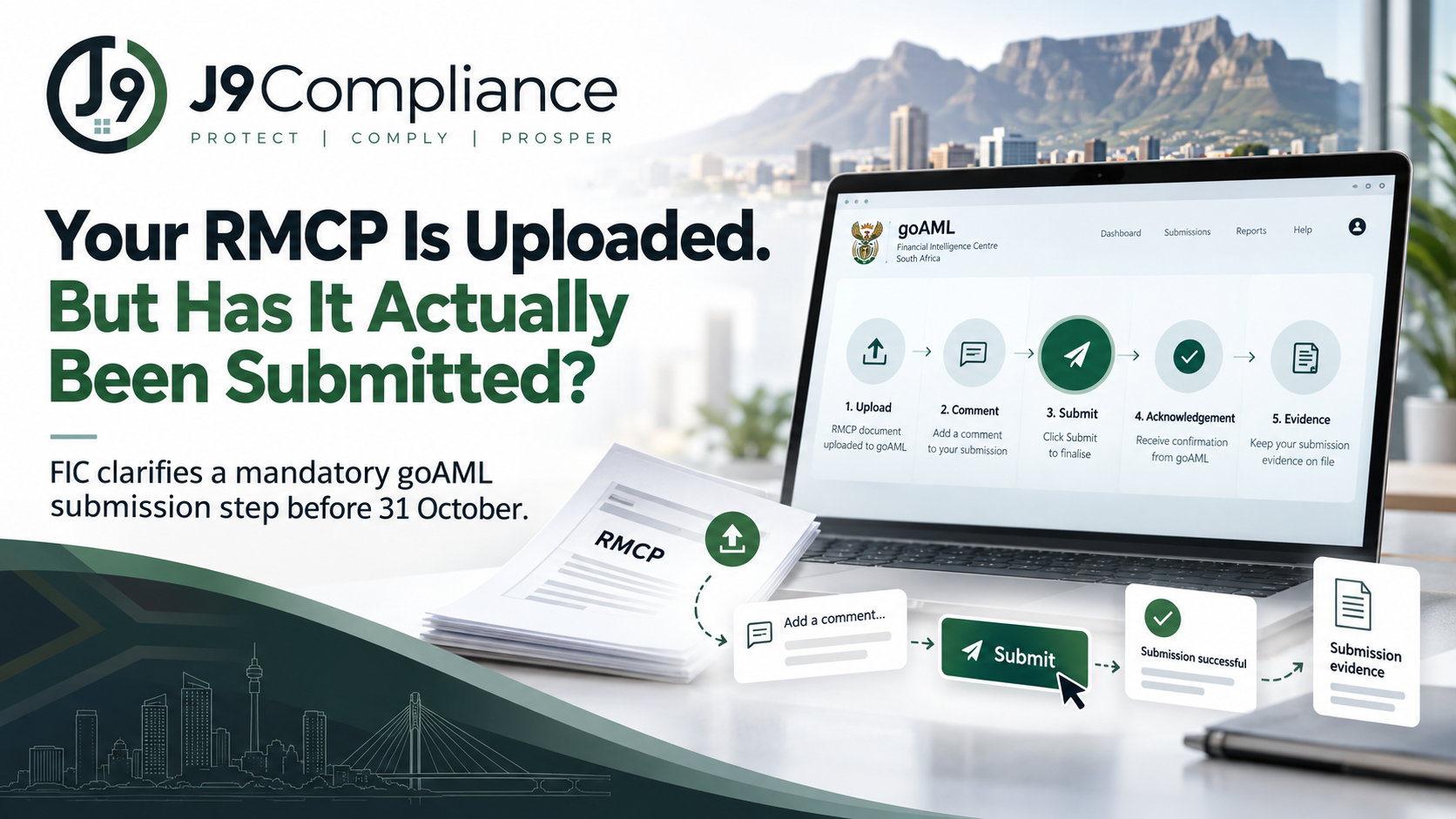
Your RMCP Is Uploaded. But Has It Actually Been Submitted?
The FIC has clarified a mandatory goAML submission step that accountable institutions should understand before completing their RMCP submission
There is an important difference between uploading an RMCP and successfully submitting an RMCP to the Financial Intelligence Centre.
And with the 31 October 2026 Directive 12 deadline for estate agencies approaching, that distinction matters.
On 9 October 2026, the Financial Intelligence Centre (FIC) issued an operational clarification about the RMCP submission process on goAML.
The FIC confirmed that a comment must be inserted during the submission process.
Without that comment, the submission button will not activate.
In other words:
Your RMCP can be uploaded to goAML without the submission actually being completed.
For principals and compliance officers preparing estate-agency RMCP submissions, this is exactly the kind of small procedural detail that can become a serious problem if it is discovered at the last minute.
What did the FIC clarify?
The FIC’s 9 October communication related specifically to Schedule 1 accountable institutions under items 1, 2, 9 and 11, whose Directive 12 deadline fell on that date.
The FIC drew particular attention to Step 5 of the RMCP submission process.
It confirmed that inserting a comment is mandatory and that:
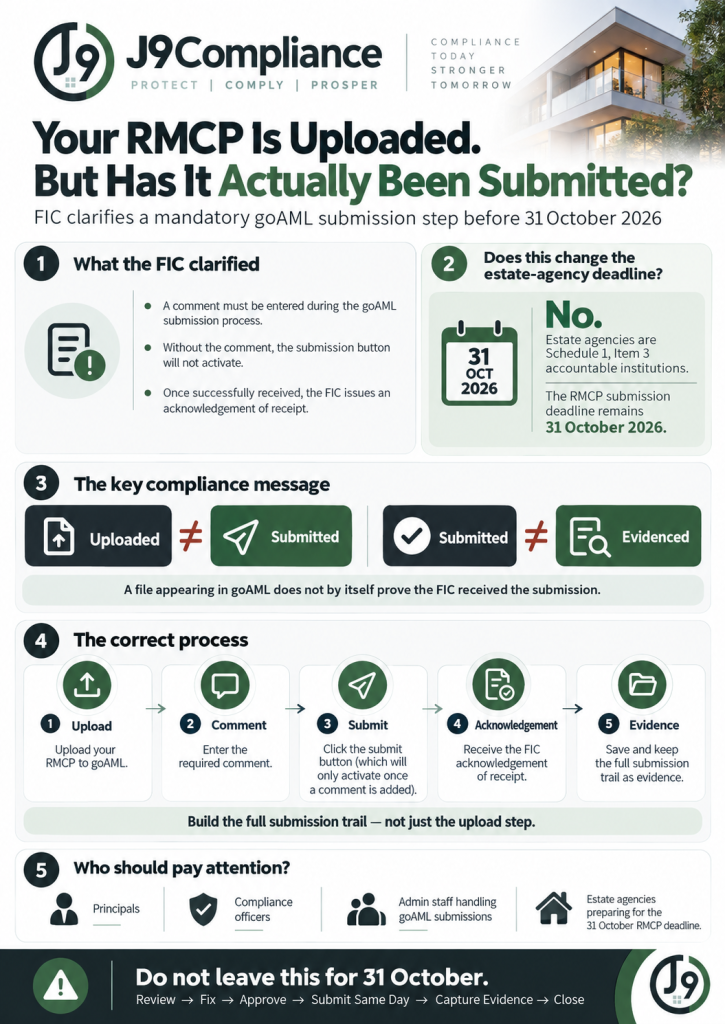
a comment must be entered before the RMCP can be submitted;
without a comment, the submission button remains inactive; and
once the RMCP has been successfully received, the FIC issues an acknowledgement of receipt.
That last point is just as important as the first.
The process should therefore not be treated simply as:
Upload document → finished.
A more accurate control is:
UPLOAD → COMMENT → SUBMIT → ACKNOWLEDGEMENT → EVIDENCE
For estate agencies approaching their own Directive 12 deadline, this is an important submission control to understand and verify in the live goAML process.
Does this change the estate-agency deadline?
No.
The 9 October communication does not announce a new deadline or an extension for estate agencies.
Property practitioners conducting estate-agency activities fall under Schedule 1, Item 3 of the FIC Act.
Their current Directive 12 RMCP submission deadline remains:
31 OCTOBER 2026
The significance of the 9 October notice is therefore not a change in the date.
It is a clarification of how the submission process must actually be completed.
And that matters because 31 October should not become the day an agency first discovers that an uploaded document has not yet been successfully submitted.
Uploaded does not mean submitted
This distinction sounds obvious.
Operationally, however, it is very easy to miss.
A person logs into goAML.
The RMCP PDF is selected.
The file appears in the system.
There is a natural temptation to think:
“It is there. We have submitted it.”
But the submission process has further steps.
If the mandatory comment has not been completed and the final submission action has not taken place, the fact that the document appears in the system does not prove that the FIC has received the submission.
That is why J9Compliance uses a simple rule:
Uploaded ≠ Submitted.
And there is a second rule that is equally important:
Submitted ≠ Evidenced.
If somebody in the agency says, “Yes, I submitted it,” the compliance file should be able to prove that statement.
What should an estate agency retain as submission evidence?
A good compliance file should allow another person to reconstruct exactly what happened without relying on memory.
For the RMCP submission, retain at least:
the final approved RMCP;
the RMCP version and approval date;
evidence of the required approval;
the exact PDF that was submitted;
the correct accountable institution and FIC organisation details;
confirmation that the correct goAML organisation/profile was used;
confirmation that the mandatory comment was completed;
the submission date;
the person who completed the submission;
the submission reference or screenshot where available; and
the FIC acknowledgement of receipt.
The acknowledgement is particularly important because it provides independent evidence that the FIC received the submission.
A screenshot showing that a file was uploaded is not the same thing.
A practical RMCP submission control
Before an estate agency closes its RMCP submission task, work through the process in sequence.
1. Confirm the accountable institution
Check that the RMCP is being submitted against the correct legal entity and FIC organisation profile.
This matters particularly where:
an agency operates more than one entity;
different branches operate under different companies;
the brand name differs from the registered legal entity;
there has been restructuring;
ownership has changed; or
the principal is unsure which organisation was originally registered with the FIC.
Do not discover an entity problem at the submission screen.
2. Confirm that the RMCP is the final approved version
The document submitted should be the RMCP that has actually been approved by the appropriate authority within the accountable institution.
Before submission, confirm:
Version → Date → Approval → Approver → Evidence
There should be no uncertainty about which version is final.
A document named:
RMCP final FINAL new corrected 2.pdf
is not a version-control system.
3. Retain the exact submission copy
Once the approved version has been identified, retain the exact PDF used for the submission.
That means the agency should be able to answer:
“Show me the exact RMCP that was submitted to the FIC.”
without recreating it afterwards.
This becomes particularly important when the RMCP is subsequently amended.
4. Log into the correct goAML organisation
Confirm that the authorised user is working within the correct organisation profile.
Where a user has access to more than one entity, this deserves particular attention.
The legal entity, FIC Org ID and Schedule 1 classification should all make sense before proceeding.
5. Upload the approved RMCP
Upload the exact approved document in accordance with the FIC’s submission requirements.
But do not stop here.
The presence of the file is not proof of completed submission.
6. Complete the mandatory comment
This is the step highlighted by the FIC on 9 October 2026.
A comment must be inserted as part of the submission process.
The FIC has confirmed that if the comment is not entered, the submission button will not become active.
For J9Compliance, this is now a hard submission control.
The RMCP should not be regarded as ready for final closeout until this step has been completed.
7. Complete the final submission action
Proceed through the required submission steps until the request has actually been submitted.
Do not interpret:
File uploaded
as:
Submission completed.
This distinction should be built into the agency’s internal checklist.
8. Look for the FIC acknowledgement
The FIC’s 9 October communication confirms that once the RMCP has been received, the FIC issues an acknowledgement of receipt.
Retain it.
It belongs in the agency’s compliance evidence.
If an acknowledgement is expected but cannot be located, investigate before treating the submission as closed.
9. Record the evidence
The compliance record should capture:
What was submitted?
Which entity submitted it?
Who submitted it?
When was it submitted?
Which version was submitted?
Was the mandatory comment completed?
What evidence proves receipt?
That creates a defensible submission trail.
Do not wait until 31 October to test this process
The 31 October 2026 deadline is a regulatory deadline.
It should not be treated as the agency’s internal production date.
This is particularly important where principals still need to:
review amendments;
approve the RMCP;
resolve entity or FIC registration questions;
regain goAML access;
verify authorised users;
confirm the correct organisation profile; or
correct deficiencies before submission.
If the RMCP is ready on 16 October, submit it on 16 October.
If it is ready on 21 October, submit it on 21 October.
There is no operational benefit in deliberately accumulating completed submissions for 30 or 31 October.
J9Compliance uses the following Rolling Close Protocol:
REVIEW → FIX → APPROVE → SUBMIT SAME DAY → CAPTURE EVIDENCE → CLOSE
Once a client is genuinely ready, the submission should move to completion.
What if goAML does not work?
Technical problems can happen.
They become much harder to manage when first discovered at the deadline.
Before submission day, agencies should therefore confirm that:
the correct authorised user can log in;
the correct organisation is visible;
the relevant organisation details are accurate;
the final RMCP is available;
the user understands the submission route; and
there is enough time to resolve an unexpected issue.
If a technical problem occurs, preserve evidence.
That may include:
screenshots;
error messages;
dates and times;
correspondence;
FIC query references; and
records of attempted resolution.
Do not rely solely on somebody remembering that “the system wasn’t working”.
Submission does not mean your RMCP is compliant
There is another important distinction.
Successfully submitting an RMCP does not mean that the FIC has approved the adequacy of that RMCP.
The FIC has previously cautioned accountable institutions against equating submission with full compliance.
The RMCP must still accurately describe the institution’s risk-based approach, controls and operating procedures — and those controls must be capable of being implemented and evidenced.
So there are really two different questions:
Question 1:
Did we successfully submit the RMCP?
That is a submission-control question.
Question 2:
Does the RMCP accurately describe a compliant system that our agency actually operates?
That is an operating-compliance question.
Both matter.
RMCP submission close is not necessarily programme close
This distinction is especially important for agencies currently updating their compliance environments.
A successful RMCP submission may close the submission workstream.
It does not automatically mean that every implementation activity is complete.
There may still be work relating to:
staff training;
staff acknowledgement;
customer due diligence procedures;
beneficial ownership;
targeted financial sanctions screening;
risk assessment;
record keeping;
reporting procedures;
registers;
file controls;
monitoring;
testing; and
corrective action.
These should not disappear because the PDF has been submitted.
Where actions remain outstanding, they should have:
an owner → an action → a due date → evidence → review
That is how a submitted RMCP becomes a living compliance programme.
The principal’s final RMCP submission checklist
Before closing the submission, ask:
PRE-SUBMISSION
☐ Correct legal entity confirmed
☐ Correct FIC Org ID confirmed
☐ Correct Schedule 1 registration confirmed
☐ goAML access tested
☐ Correct authorised user confirmed
☐ Final RMCP completed
☐ RMCP formally approved
☐ Approval evidence retained
☐ Exact approved PDF identified
SUBMISSION
☐ Correct goAML organisation opened
☐ Exact approved RMCP uploaded
☐ Mandatory comment completed
☐ Final submission action completed
EVIDENCE
☐ FIC acknowledgement received
☐ Screenshot/reference retained where applicable
☐ Exact submitted RMCP retained
☐ Submission date recorded
☐ Submitter recorded
☐ Evidence filed in the compliance record
Only then should the agency be comfortable saying:
“Our RMCP has been submitted.”
31 October is not an upload exercise
The objective is not simply to get a PDF onto goAML before midnight.
The objective is to be able to demonstrate:
We reviewed it.
We fixed what needed fixing.
The correct authority approved it.
We submitted the correct version.
We completed the required submission process.
The FIC received it.
We retained the evidence.
And, importantly:
We are implementing what the RMCP says we do.
That is the difference between document compliance and operating compliance.
Need help getting to submission-ready?
If your estate agency is preparing for the 31 October 2026 RMCP submission deadline and you are uncertain about your RMCP, goAML readiness or submission controls, J9Compliance can help identify what still needs to be completed before closeout.
J9Compliance
Protect | Comply | Prosper
This article is intended as general compliance information and should be read together with the applicable FIC Act requirements, Directive 12 and current Financial Intelligence Centre guidance..
J9Compliance | Protect. Comply. Prosper.
This article provides general compliance information and does not constitute legal advice, PPRA certification or a regulatory determination. Agencies and practitioners should confirm the application of the PPRA requirements to their individual circumstances.
Get Your Compliance Sorted
The recent sanctions are not isolated incidents – they represent an enforcement programme that is rapidly expanding. Being FICA compliant requires an operational, fully documented programme that your staff understands and applies daily.
If your agency’s Risk Management and Compliance Programme isn’t up to standard, don’t wait for the FIC to find the gaps.