

South Africa’s New Property Practitioner Pathway: What Principals Need to Know
The qualification route for candidate property practitioners has changed — and the most important consequence may not be the new examination. It may be the increased responsibility placed on agencies, principals and mentors to prove that practical competence has actually been developed.
The Property Practitioners Regulatory Authority’s Professional Competency Certification Practice Note, effective 1 October 2026, introduces a new pathway for people seeking to qualify as non-principal property practitioners.
At first glance, much of the attention is likely to fall on one obvious change: a new closed-book PPRA examination.
But the bigger shift is structural.
The new pathway places practical workplace learning, supervision, evidence and mentor verification at the centre of the qualification process.
For estate agencies, that turns candidate development into a much more visible governance responsibility.
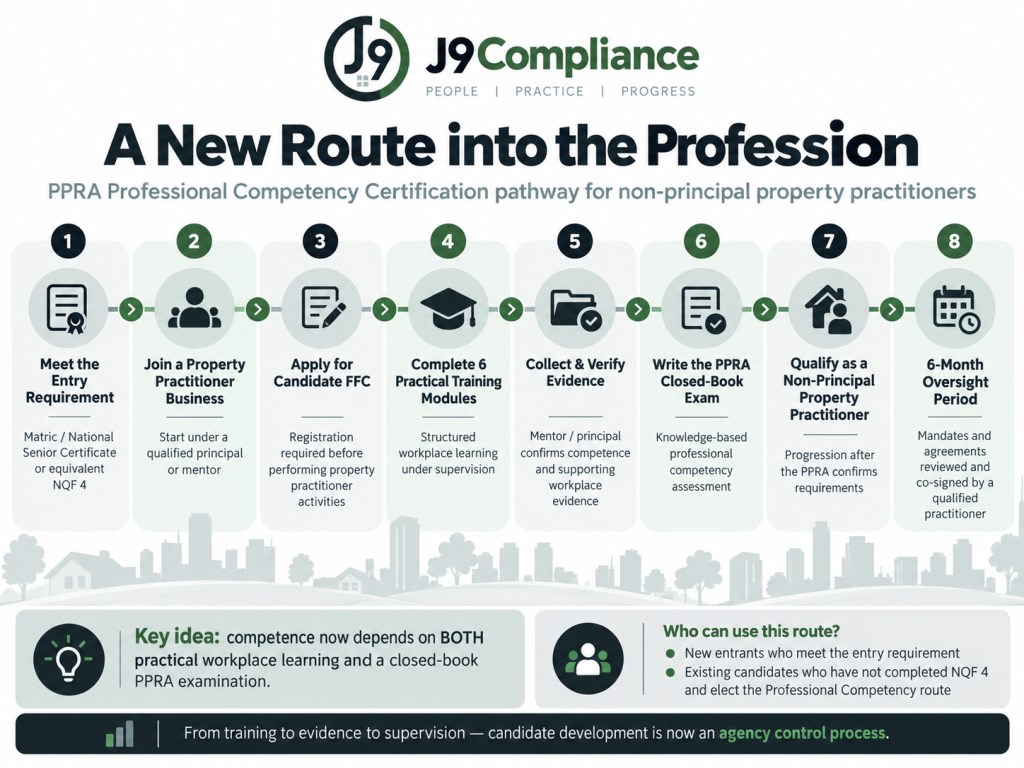
A new route into the profession
The PPRA describes the Professional Competency Certification pathway as a mechanism intended to broaden access to the property profession while maintaining appropriate competency standards.
The stated objectives include creating a shorter, more affordable pathway, supporting competence through both theoretical knowledge and workplace experience, and supporting the transformation objectives of the Property Practitioners Act.
Candidates entering the Professional Competency Certification route must meet a minimum entry requirement of a National Senior Certificate — Matric — or an equivalent NQF Level 4 qualification. From 1 October 2026, the route is available both to qualifying new entrants and to certain existing candidate property practitioners who have not completed the prescribed NQF Level 4 Real Estate qualification.
The pathway combines two important components:
Knowledge competency, demonstrated through a PPRA examination; and
Practical competency, demonstrated through six prescribed practical training modules completed under supervision.
The PPRA expressly states that professional competence is demonstrated through both knowledge and practical application. Passing the examination demonstrates the required knowledge standard, while completion of the six practical modules demonstrates the ability to apply that knowledge in practice.
That distinction matters.
Passing an examination is no longer the whole story.
The closed-book examination
Under the new Professional Competency Certification route, candidates will write a prescribed closed-book PPRA examination.
The examination will assess areas including:
property legislation;
regulatory compliance;
contract law;
property-related agreements;
ethics and professional conduct;
consumer protection;
fiduciary responsibilities;
property transaction processes; and
industry best practice.
The Practice Note provides that examinations will be offered at least four times per year and will take the form of a closed-book assessment.
The first examination is expected in March 2027, with March, June, September and December identified as the intended examination months, subject to confirmation of dates.
The change from an open-book or take-home environment to a closed-book examination is significant.
It places greater emphasis on the practitioner actually understanding the legislative, ethical and transaction environment in which they operate.
But J9Compliance believes that agencies should resist viewing this simply as an “exam-preparation” issue.
The examination is only one part of the pathway.
Six practical modules – and evidence that they actually happened
The PPRA’s practical training framework consists of six modules aligned to real workplace activity.
The practical training areas include regulatory and contractual processes, ethics and the Code of Conduct, client relationships and databases, brand and market development, property transaction activities, and financial and business principles.
The later modules include activities such as identifying client needs, qualifying clients, obtaining mandates, preparing agreements, marketing properties, managing property-related processes and applying financial business principles.
These are not abstract classroom exercises.
They are intended to demonstrate the candidate’s ability to operate within a real professional environment.
That is where the agency’s responsibility becomes important.
Can somebody start before becoming a registered candidate?
This aspect of the new framework needs careful explanation.
The Practice Note states that registration as a candidate property practitioner is not a prerequisite for studying, writing examinations or achieving prescribed qualification standards.
That does not, however, mean an unregistered person may simply begin performing estate agency activities.
The Practice Note is equally clear that a person may not perform property practitioner activities unless registered with the PPRA and in possession of the appropriate Fidelity Fund Certificate.
The FFC remains a prerequisite for the lawful rendering of property practitioner services.
This is an important distinction for agencies recruiting new people.
Learning can begin before practice. Regulated property practitioner activity cannot.
Principals should make sure their recruitment, induction and supervision processes recognise that difference.
The principal or mentor becomes part of the evidence chain
This may be the most important operational consequence of the new pathway.
The Practice Note makes the mentor responsible for:
guiding workplace learning;
supervising practical activities;
monitoring progress;
verifying workplace evidence;
assessing demonstrated competence; and
confirming readiness for professional practice.
The candidate must therefore do more than attend training.
Workplace evidence has to exist.
The PPRA requires evidence of practical competence to include completion of prescribed activities, supporting workplace evidence, mentor or principal verification and any required workplace assessments.
That evidence must also be retained and may be subject to audit or verification.
For principals, this raises a series of very practical questions.
Who is the appointed mentor?
Is that person suitably qualified?
Where is the candidate’s evidence stored?
Who confirms each module?
How is progress monitored?
What happens if evidence is incomplete?
Who checks that the candidate is still within the permitted timeframe?
And can the agency prove all of this later?
Those are not training-provider questions.
They are governance and control questions.
The 180-day candidate period
The Practice Note defines the 180-day Candidate Period as the maximum period calculated from the date on which the candidate’s first FFC is issued during which the person may practise as a Candidate Property Practitioner.
A candidate may not continue practising beyond this period without PPRA consent.
For candidates following the Professional Competency Certification route, this places real importance on dates.
The agency needs to know:
FFC issue date → practical training progress → examination readiness → submission of evidence → qualification status.
The Practice Note also deals specifically with existing candidates who have already been registered for extended periods.
Candidates registered for more than 12 months must qualify as non-principal property practitioners within 180 days, subject to the transitional provisions and available routes described by the PPRA.
Because the first closed-book examination will only be available in March 2027, the Practice Note provides a transitional extension until 30 June 2027 for affected candidates to complete the relevant training and examination requirements.
Thereafter, the 180-day period is intended to be applied strictly.
That makes candidate tracking a genuine compliance-control issue.
Qualification does not immediately end supervision
There is another control that agencies should not overlook.
Once the candidate has successfully completed the pathway and becomes a Non-Principal Property Practitioner, supervision does not disappear immediately.
For a further six months, mandates for the sale or letting of property and agreements of sale or lease must be reviewed and co-signed by a qualified property practitioner in accordance with Regulation 33.3.1.
So there are effectively two supervision periods to manage:
Candidate stage: active supervision while developing competence.
Post-qualification stage: six months of review and co-signing of specified mandates and agreements.
If an agency does not track both, a candidate can pass through the qualification process while the operational controls around them remain incomplete.
Three routes – not one
The Practice Note also makes clear that candidates are not all in the same position.
A new entrant may choose the Professional Competency Certification pathway.
An existing candidate who has not completed NQF Level 4 may, if eligible, elect that route.
An existing candidate who has already commenced NQF Level 4 may continue with the qualification and the existing PDE4 route, or may in certain circumstances switch to the Professional Competency Certification pathway.
Candidates intending to progress to NQF Level 5 or a higher qualification, however, still need to complete the NQF Level 4 qualification.
This is one reason agencies should be cautious about giving candidates informal advice based on a simplified diagram or social-media summary.
The correct route depends on the candidate’s existing status, qualification history and intended progression.
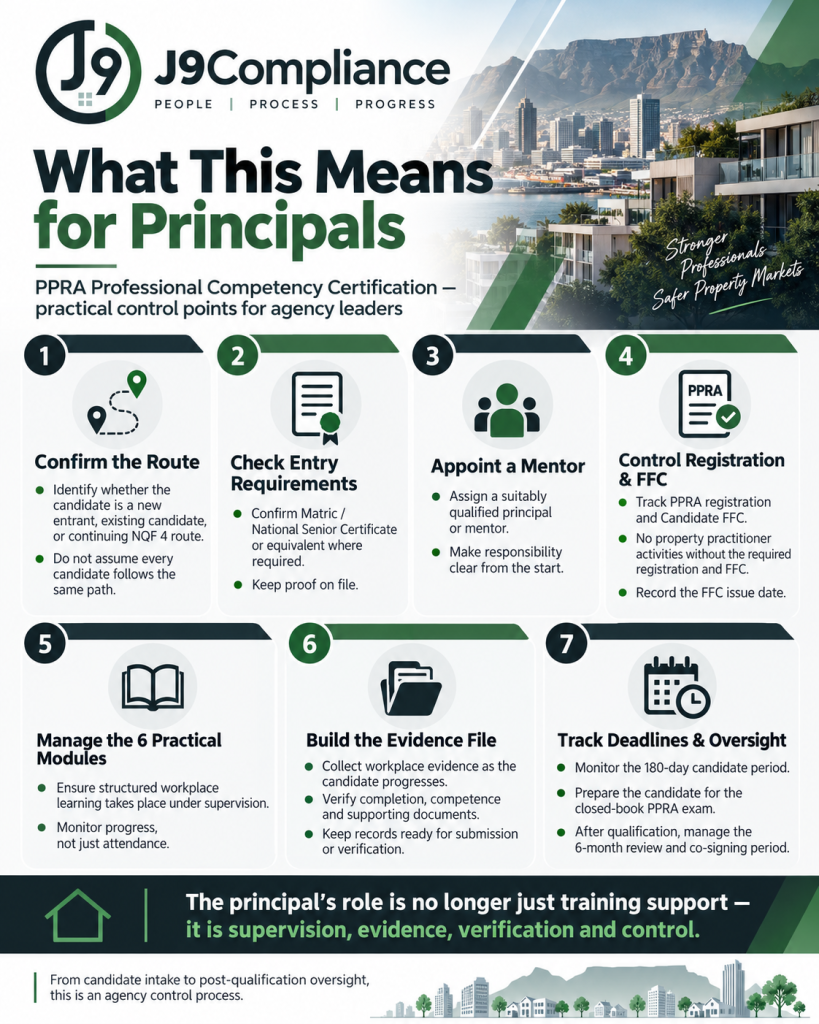
What this means for principals
The PPRA’s own implementation checklist is revealing.
When the candidate starts, the business should confirm Matric, determine whether the Professional Competency Certification applies, begin the registration/FFC process, appoint an appropriate mentor, commence the six practical modules and explain the evidence requirements.
During training, the candidate completes activities, the mentor supervises, evidence is collected and verified, and examination preparation takes place.
At completion, the modules and competence are verified, the required documents are submitted, and the candidate registers for the closed-book examination.
After the examination, progression requirements are completed and the additional six-month oversight period begins.
That is effectively a control framework.
For J9Compliance, the question is therefore not simply:
“Has your candidate done the course?”
The better questions are:
Can your agency demonstrate the candidate’s pathway from recruitment to competence?
Can you prove who supervised them?
Can you retrieve the evidence?
Can you identify the 180-day deadline?
Can you show when the six-month post-qualification oversight period began and ended?
Can the principal see all of this without searching through emails, WhatsApps and disconnected files?
That is operating compliance.
Training is only one layer
There is an important opportunity here for training organisations and practical learning tools.
A closed-book examination increases the importance of genuine knowledge retention.
Scenario-based learning, discussion, repetition and practical application may therefore become increasingly valuable.
But training support and regulatory evidence control should not be confused.
A training tool can help a candidate learn.
The agency must still be able to demonstrate that the prescribed workplace activities, mentoring, supervision and evidence requirements have been properly completed.
Those are different responsibilities.
And principals ultimately need visibility across both.
A better way to think about candidate compliance
The new candidate pathway could be viewed simply as another PPRA procedural change.
We think that would miss the bigger point.
It creates an opportunity for agencies to professionalise the way they recruit, train, supervise and release new practitioners into the market.
Instead of a candidate file being assembled retrospectively when someone asks for evidence, the agency can build the evidence as the practitioner progresses.
Candidate → Mentor → Practical Modules → Evidence → Verification → Examination → Status Upgrade → Six-Month Oversight → Full Operational Release
That is not more bureaucracy.
Done properly, it is a clearer operating system.
And as South Africa’s property-sector compliance requirements continue to mature, agencies that can demonstrate how their people are trained, supervised and controlled will be in a materially stronger position than agencies that simply assume the paperwork exists somewhere.
J9Compliance view
The Professional Competency Certification pathway creates a new access route into the profession.
But it also creates a new responsibility for principals.
The opportunity is to treat candidate development not merely as an education process, but as a controlled business process with defined responsibility, evidence and oversight.
That is where training becomes competence.
And where documented compliance becomes operating compliance.
J9Compliance | Protect. Comply. Prosper.

J9Compliance | Protect. Comply. Prosper.
This article provides general compliance information and does not constitute legal advice, PPRA certification or a regulatory determination. Agencies and practitioners should confirm the application of the PPRA requirements to their individual circumstances.
Get Your Compliance Sorted
The recent sanctions are not isolated incidents – they represent an enforcement programme that is rapidly expanding. Being FICA compliant requires an operational, fully documented programme that your staff understands and applies daily.
If your agency’s Risk Management and Compliance Programme isn’t up to standard, don’t wait for the FIC to find the gaps.