
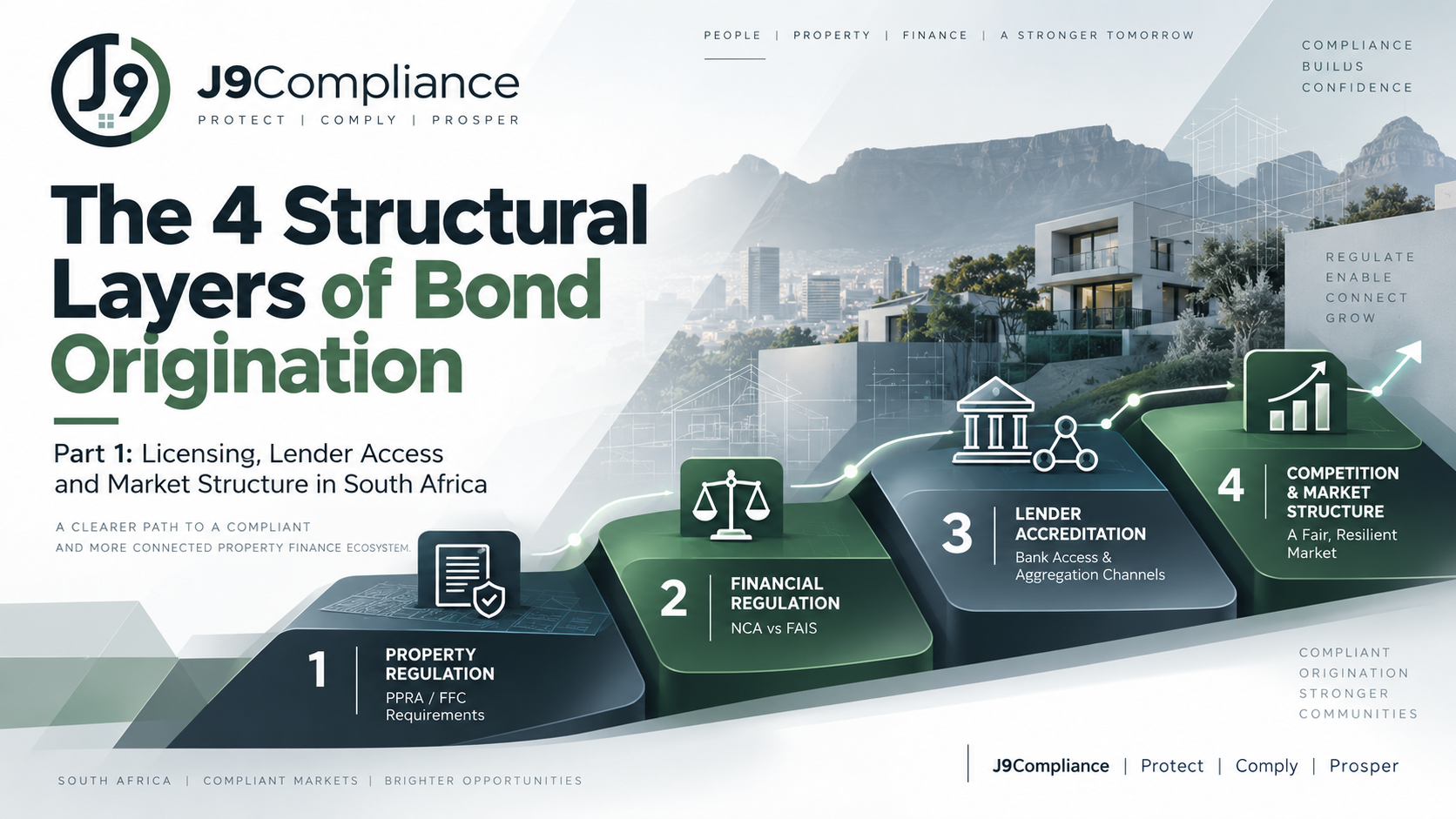
The 4 structural layers of Bond Origination
Part 1: Licensing, Lender Access and Market Structure in South Africa
The ongoing debate over the registration of independent bond originators highlights a critical fault line in South Africa’s property and finance sectors. While frustration is currently directed at the Property Practitioners Regulatory Authority (PPRA) regarding the issuance of Fidelity Fund Certificates (FFCs), treating this purely as an administrative issue misses the structural reality of the market. To understand why independent bond brokers struggle to operate autonomously, the market must be mapped across four distinct layers: statutory property regulation, financial credit law, commercial lender arrangements, and competition dynamics.
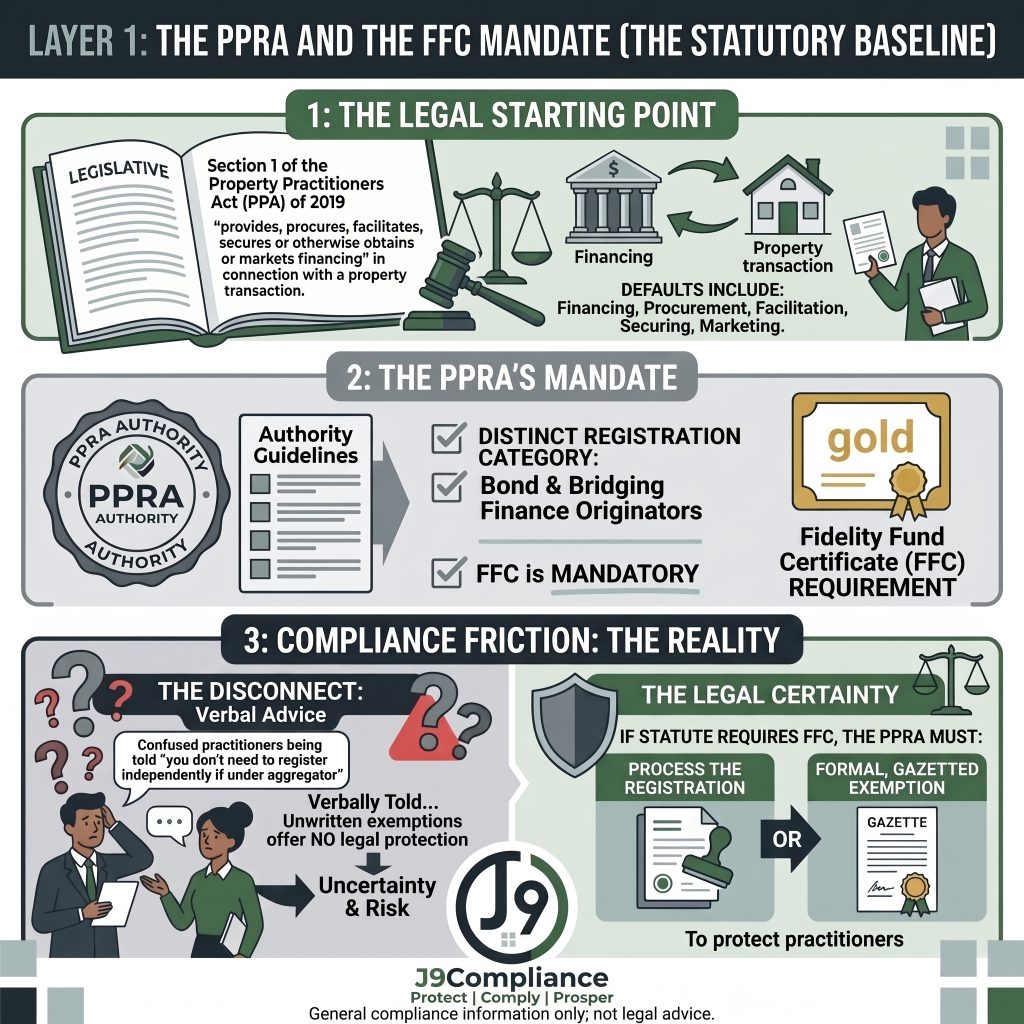
Layer 1: The PPRA and the FFC Mandate (The Statutory Baseline)
The statutory starting point is strong, although not entirely without qualification. Under Section 1 of the Property Practitioners Act (PPA) of 2019, the definition of a property practitioner explicitly includes anyone who “provides, procures, facilitates, secures or otherwise obtains or markets financing” in connection with a property transaction.
- The PPRA’s Own Mandate: The Authority’s guidelines list “Bond and Bridging Finance Originators” as a distinct registration category requiring an FFC.
- The Compliance Friction: Practitioners report a disconnect between the legislation and the regulator’s operational behavior, noting instances where they are verbally told they do not need to register independently if they fall under an aggregator. However, unwritten verbal exemptions offer no legal protection. If the PPRA considers an applicant exempt from a requirement that otherwise appears applicable, that position should be capable of being supported by a written decision, applicable exemption or other identifiable legal basis. Informal verbal guidance leaves the practitioner carrying unnecessary regulatory risk.
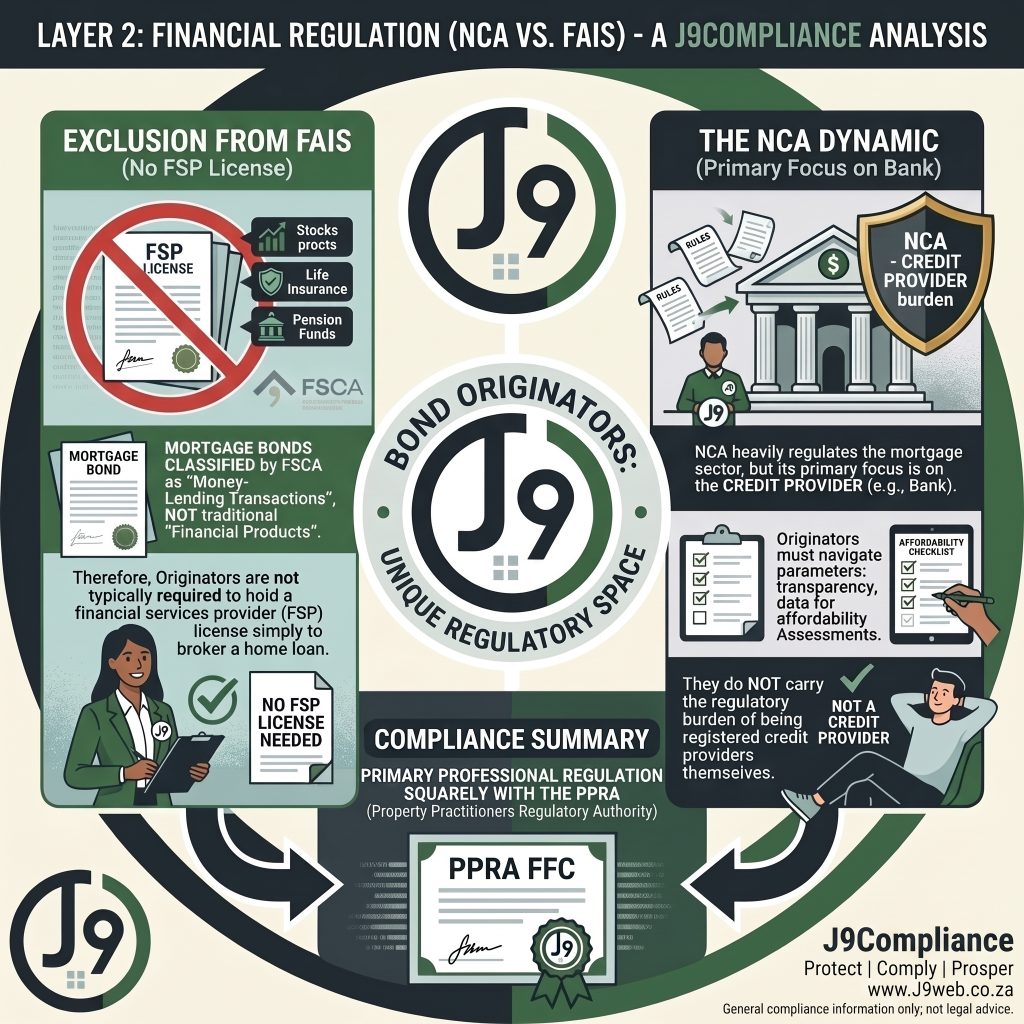
Layer 2: Financial Regulation (NCA vs. FAIS)
Bond originators sit in a unique regulatory space between property law and financial services.
- Exclusion from FAIS: The Financial Sector Conduct Authority (FSCA) has historically classified mortgage bonds as money-lending transactions rather than traditional “financial products” under the FAIS Act. Therefore, originators are not typically required to hold a financial services provider (FSP) license simply to broker a home loan.
- The NCA Dynamic: The National Credit Act (NCA) heavily regulates the mortgage sector, but its primary focus is on the Credit Provider (the bank extending the loan) rather than the intermediary. While originators must navigate NCA parameters – such as transparency and providing data for affordability assessments – they do not carry the regulatory burden of being registered credit providers themselves. For pure mortgage-origination activity, the PPRA therefore becomes a central statutory professional-regulation layer, alongside the credit-law obligations governing the underlying transaction.
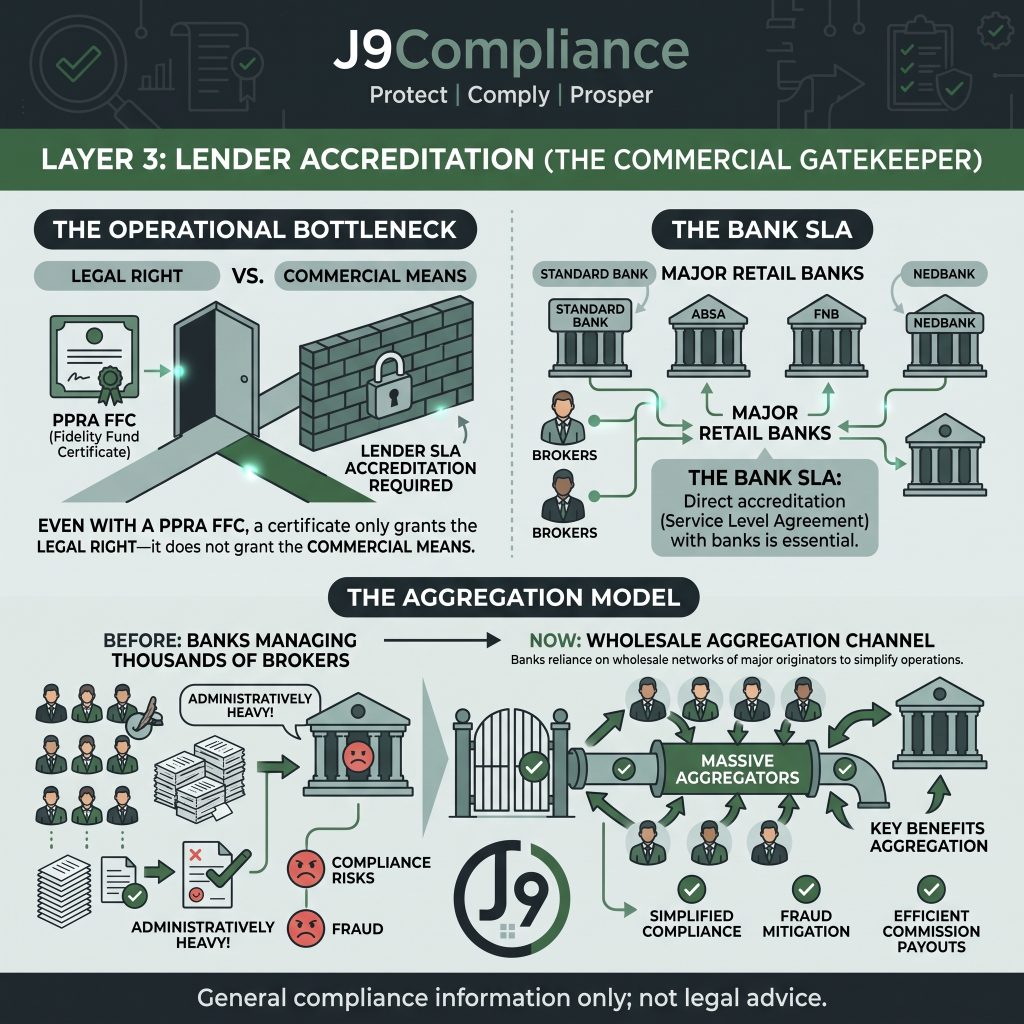
Layer 3: Lender Accreditation (The Commercial Gatekeeper)
This layer is the true operational bottleneck of the industry. Even if the PPRA were to issue an FFC to an independent bond originator tomorrow, that certificate only grants the legal right to operate – it does not grant the commercial means to do so.
- The Bank SLA: To originate a bond, a broker must have a Service Level Agreement (SLA) or direct accreditation with the major retail banks (Standard Bank, ABSA, FNB, Nedbank).
- The Aggregation Model: In practice, access to lenders is governed by commercial accreditation and distribution arrangements. Many smaller originators operate through larger origination, aggregation or franchise networks that already have lender relationships. The precise criteria by which individual banks grant direct origination access are commercial matters and may differ between lenders. Processing compliance, mitigating fraud, and managing commission payouts for micro-entities is administratively heavy. Instead, banks rely on wholesale aggregation channels. They issue direct SLAs to massive originators, requiring independent brokers to route their applications through these established corporate networks.
Layer 4: Competition and Market Structure
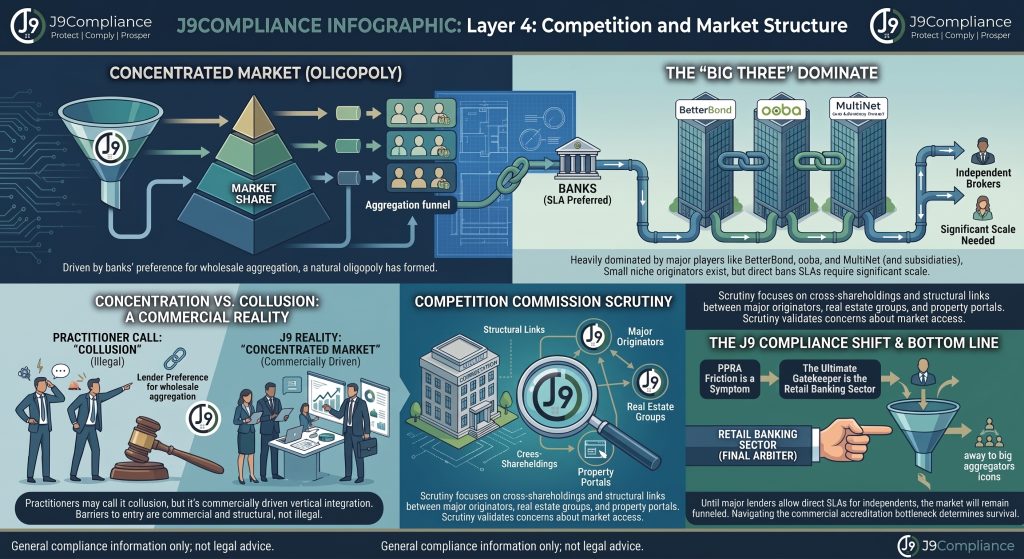
Because of the banks’ preference for wholesale aggregation, a highly concentrated market structure has historically developed.
- The “Big Three”: As noted by industry participants, the landscape is heavily dominated by major players like BetterBond, ooba, and MultiNet (and their subsidiary brands). While there are smaller niche originators, achieving the scale required to secure direct bank SLAs is exceptionally difficult.
- Concentration vs. Collusion: Frustrated practitioners often label this structure as “collusion,” but it is more accurately described as a highly concentrated, vertically integrated market driven by lender preferences. The Competition Commission has previously scrutinized the property ecosystem, particularly cross-shareholdings and structural links between major originators, real estate groups, and property portals. While this scrutiny validates concerns about market access, the barriers to entry are primarily commercial and structural rather than illegal.
If we follow the thread through all four layers, the J9Compliance perspective shifts. The PPRA issue remains important: where legislation and the regulator’s own published material contemplate registration of bond originators, practitioners are entitled to seek clear, written and legally grounded answers when registration is declined or considered unnecessary.
But an FFC answers only the regulatory permission question. It does not necessarily answer the commercial market-access question.
An independent originator may still need access to lender systems, accreditation arrangements and distribution agreements before it can compete effectively. If that access is available primarily through a small number of established origination or aggregation networks, the resulting market-access question deserves separate examination.
That is where the next enquiry should go.
Who may legally operate? Who may commercially access the lenders? And are the rules governing those two gateways transparent, consistent and open to genuine independent participation?
The regulatory puzzle is therefore bigger than an FFC. It sits at the intersection of licensing, credit regulation, lender access and competition.
J9Compliance
Protect | Comply | Prosper
General compliance information only; not legal advice.