
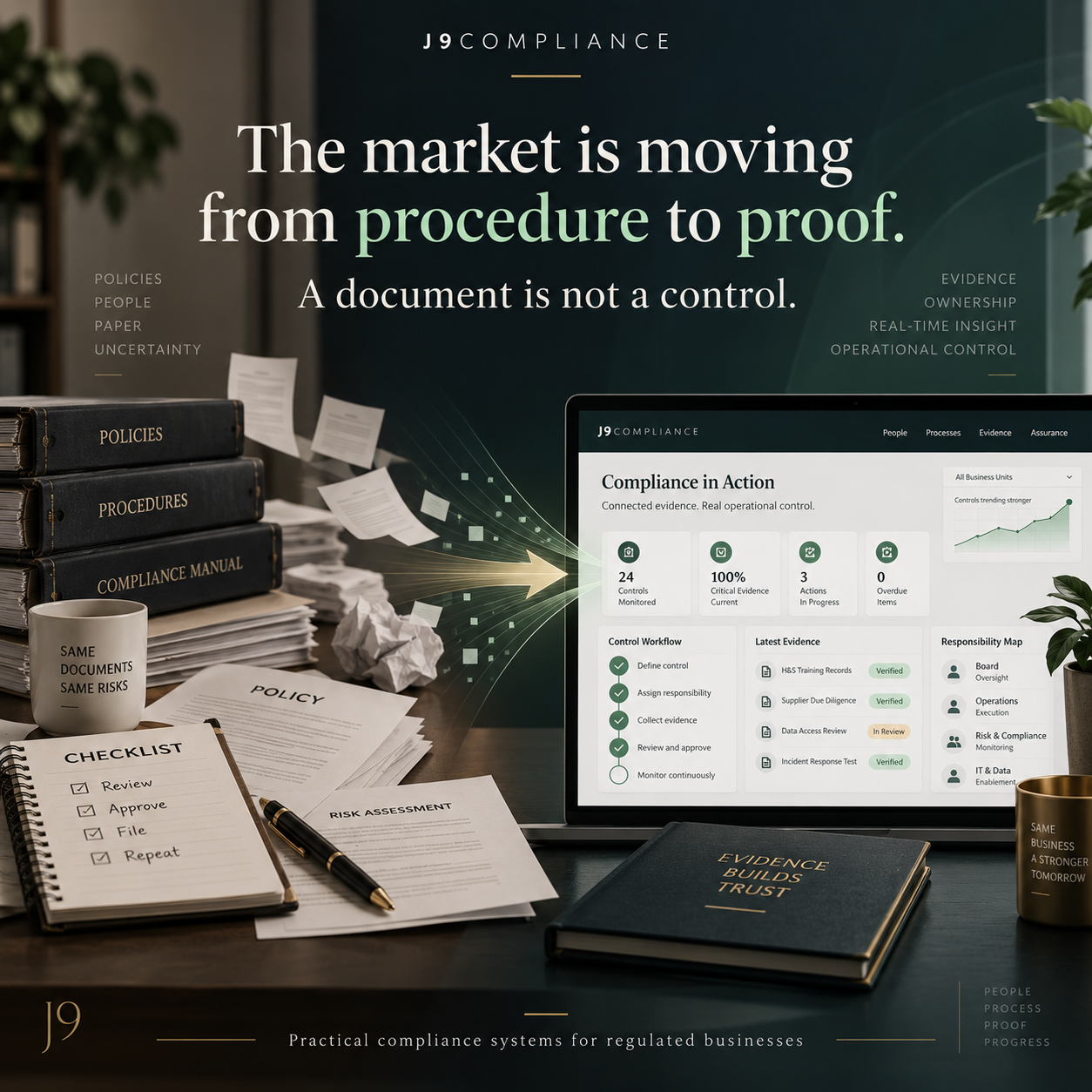
The Market Is Moving From Procedure to Proof
From Procedure to Proof: The Future of Compliance | J9Compliance
For years, many regulated businesses have treated compliance as a documentation exercise.
The policy exists.
The register exists.
The procedure has been written.
The training was attended.
The file has been signed.
And therefore, the assumption is that the control exists.
Increasingly, that assumption is no longer enough.
Across property, financial services, security, governance and other regulated environments, the question is changing.
It is moving from:
“Do you have the procedure?”
to:
“Can you show that the procedure is actually working?”
That is a much more significant shift than it first appears.
Because a document can tell you what should happen.
Evidence tells you what did happen.
And operational control tells you whether the business can see, manage and correct the difference.
A document is not a control
A beautifully written policy can sit untouched on a server for three years.
A training attendance register can prove that somebody attended a session without proving that the process was subsequently followed.
A client file can contain twenty documents and still be missing the one piece of evidence that matters.
A register can exist without anyone knowing who is responsible for keeping it current.
An RMCP can be signed and approved while different practitioners continue using different versions of the process.
None of those examples necessarily means that a business is deliberately non-compliant.
They usually point to a more ordinary problem:
compliance exists as paperwork, but not yet as an operating system.
That distinction matters.
A control is not simply something that has been documented.
A control has an owner. It has a purpose. It is performed. It creates evidence. It can be checked. And when it fails, somebody knows what happens next.
The next question is not “Do you have it?”
Consider how quickly the quality of a compliance conversation changes when we change the question.
Instead of asking:
“Do you have an RMCP?”
ask:
“How do you know your practitioners are working from the current RMCP?”
Instead of:
“Have your staff received training?”
ask:
“Can you show which practitioners completed which training, when it happened, and whether the required acknowledgements and evidence are retained?”
Instead of:
“Do you screen clients?”
ask:
“Where is the screening evidence, who performed it, when was it performed, and what happens if the result requires escalation?”
Instead of:
“Do you check files?”
ask:
“How does the principal know which files are complete, which controls are outstanding and who is responsible for resolving them?”
Those questions move the conversation from documentation to operating reality.
And that is where compliance becomes useful.
Procedure without visibility creates false comfort
There is a danger in having enough paperwork to create the appearance of control.
When a procedure exists, management can reasonably believe the requirement has been dealt with.
But if the organisation cannot see whether that procedure is being followed, the document may actually create false comfort.
This is why visibility matters.
A principal should not have to personally open every file to understand whether the agency’s controls are functioning.
A compliance officer should not have to search through email chains to work out whether training evidence exists.
A manager should not discover an expired document only when somebody asks to see it.
The purpose of a compliance system is not to create more administration.
It is to create visibility.
What is current?
What is missing?
What has been completed?
What requires escalation?
Who owns the next action?
What evidence exists?
What needs to be reviewed again?
Those are management questions as much as compliance questions.
Evidence changes the quality of governance
Once evidence is structured, something else becomes possible.
The organisation can begin learning from its own compliance activity.
Patterns become visible.
Perhaps one control is repeatedly missed across multiple client files.
Perhaps one branch is consistently late completing a particular process.
Perhaps practitioners misunderstand the same requirement despite having attended training.
Perhaps certain documents repeatedly expire without being renewed.
Perhaps corrective actions remain open for too long.
Now compliance is no longer simply proving that a document exists.
It begins providing information about how the business operates.
That is the progression:
Procedure → Control → Evidence → Visibility → Insight → Corrective action
And that is where good governance becomes increasingly powerful.
The question is no longer only whether somebody performed a task.
It becomes:
What is the evidence telling us about the organisation?
This matters particularly in property
South African property businesses operate across multiple regulatory obligations.
FICA requirements sit alongside Property Practitioners Act obligations, POPIA, consumer requirements, rental processes and ordinary business governance.
The principal may have an RMCP.
The practitioners may have FFCs.
Training may have taken place.
Client due diligence may be happening.
Screening may be performed.
Forms may have been approved.
But those activities often live in different places.
Documents in one folder.
Training records somewhere else.
Practitioner information in a spreadsheet.
Client evidence inside individual transaction files.
Screening results in an inbox.
Corrective actions in somebody’s notebook.
The challenge is therefore not always the absence of compliance activity.
It is the absence of connection.
That is why the future of property compliance is unlikely to be another larger manual.
It is a clearer operating view connecting:
documents, people, files, evidence, responsibility and monitoring.
Technology will accelerate this change
Technology makes it increasingly unnecessary to manage important controls blindly.
Structured workflows can identify missing information.
Digital repositories can retain evidence.
Dashboards can surface exceptions.
Automated reminders can identify approaching deadlines.
AI can help organise information, identify patterns and support review.
But technology does not remove accountability.
In fact, the more technology becomes involved in compliance processes, the more important clear accountability becomes.
Who approved the action?
What evidence was used?
Was that evidence current?
Can the decision be reviewed?
Can a permission be revoked?
Can the organisation reconstruct what happened?
The objective should not be to automate responsibility away.
It should be to make responsibility more visible.
From compliance burden to control
This is the shift J9Compliance is building around.
We believe regulated businesses need fewer disconnected compliance activities and a clearer understanding of how the pieces work together.
That begins by understanding the position that exists today.
Not the perfect version.
Not the inspection-ready version.
The real version.
What is working?
What evidence already exists?
Where are the gaps?
Who owns what?
What needs attention first?
From there, compliance can move through a practical pathway:
Assess → Design → Build → Implement → Evidence → Sign-off → Monitor
The objective is not more paperwork.
It is stronger operational control.
The question every principal should be asking
If a regulator, client, auditor or board member asked tomorrow:
“Show me how this control actually works inside your business.”
could you do it?
Could you identify the responsible person?
Could you produce the evidence?
Could you show when the control was last performed?
Could you identify outstanding exceptions?
Could you demonstrate what happens when something goes wrong?
If the answer is not yet clear, that does not mean the business has failed.
It simply means there is work to do in connecting the procedure to the proof.
And that is increasingly where modern compliance begins.
Start with what you have
You do not need a perfect compliance file before asking for help.
The J9 Agency Compliance Pathway Map helps property principals see what appears to be working, what needs attention, who owns what and what should happen next.
See where you are. Know what comes next.
Agency Compliance Pathway Map — R950
Credited in full against an implementation project approved within seven days.
J9Compliance | Protect • Comply • Prosper