

Capital Follows Corridors. Compliance Must Follow the Transaction.
Beyond the Isolated Market:
The Rise of Investment Corridors
For years, African real estate strategy has been framed by isolated geographic questions: Which country is growing? Which city is the next investment hotspot?
Ahead of the launch of the Broll Africa Real Estate Intelligence Report 2026 at the Africa Property Investment Summit in Cape Town, a compelling counter-thesis has emerged: real estate opportunity is defined by interconnected corridors - shaped by trade routes, energy grids, ports, digital infrastructure, migration, and capital flows.
However, this macroeconomic shift creates a critical operational question: If capital follows corridors across borders and systems, what happens to compliance?
The reality is that while legislation remains jurisdiction-specific, the business activity creating regulatory exposure no longer sits neatly inside a single document, agency, or jurisdiction. Compliance must follow the transaction.The Anatomy of the Modern Property Ecosystem
A single property deal is no longer just a buyer-seller agreement. It is an interconnected web of data, identity, and accountability.
"The Ecosystem Behind a Transaction" that maps out the relationship between data, identity, and accountability as described in the model.
Every connection creates information. That information may create regulatory obligations, and those obligations require more than an expressed intention to comply - they require effective controls and evidence.
Shift 1: A Document Is Not a ControlHistorically, compliance has often been treated as an administrative exercise: maintaining a manual, a checklist, a policy file or a spreadsheet. But holding a policy does not prove that an underlying risk is actively managed. A static compliance manual, on its own, cannot adequately respond to a business environment in which geography, counter-parties, risk and regulatory obligations may change.Under guidelines from regulatory bodies like South Africa’s Financial Intelligence Centre (FIC), a Risk Management and Compliance Programme (RMCP) requires active risk assessment, customer due diligence, and ongoing controls.
When economic geography changes, compliance risk changes with it. When economic geography changes, compliance risk can change with it. The control environment therefore needs to remain responsive to changes in geography, counter-parties, evidence and regulatory obligations.
Shift 2: The AI Governance Dilemma - Automation vs. Admissibility
Artificial intelligence is increasingly being integrated into property operations - from lead qualification and document processing to screening and decision support. While the operational gains are massive, AI introduces a crucial governance challenge:
Circumstances evolve rapidly: permissions expire, client risk classifications change, sanction lists update, and documentation becomes stale. An action authorized during system setup is not automatically compliant 30 days later
The Emergence of Property Compliance Intelligence
To operate responsibly across connected corridors, the sector must transition from compliance administration to Property Compliance Intelligence.
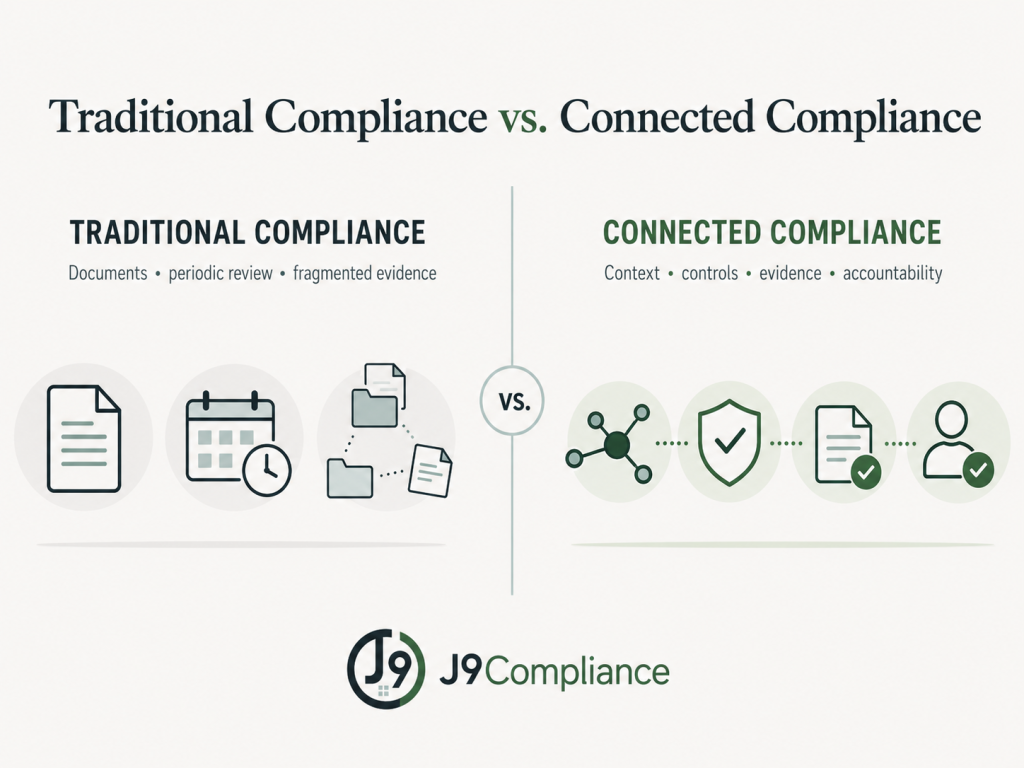
The next generation of compliance will need to connect entities, people, transactions, regulatory obligations, controls and evidence in a way that is observable and capable of responding when circumstances change.Africa's real estate markets do not need more compliance noise or 300-page manuals that sit unread on a server. Connected markets require connected compliance - where capital, data, technology, and risk are governed through a single, observable operational lens.
The emerging opportunity is Property Compliance Intelligence.The next generation of compliance will need to connect entities, people, transactions, regulatory obligations, controls and evidence in a way that is observable and capable of responding when circumstances change.
At J9Compliance, this is the direction we are working toward: helping property businesses move from fragmented compliance administration toward a clearer view of where they are, what applies, what evidence exists and what needs to happen next.
Connected markets require connected compliance.