
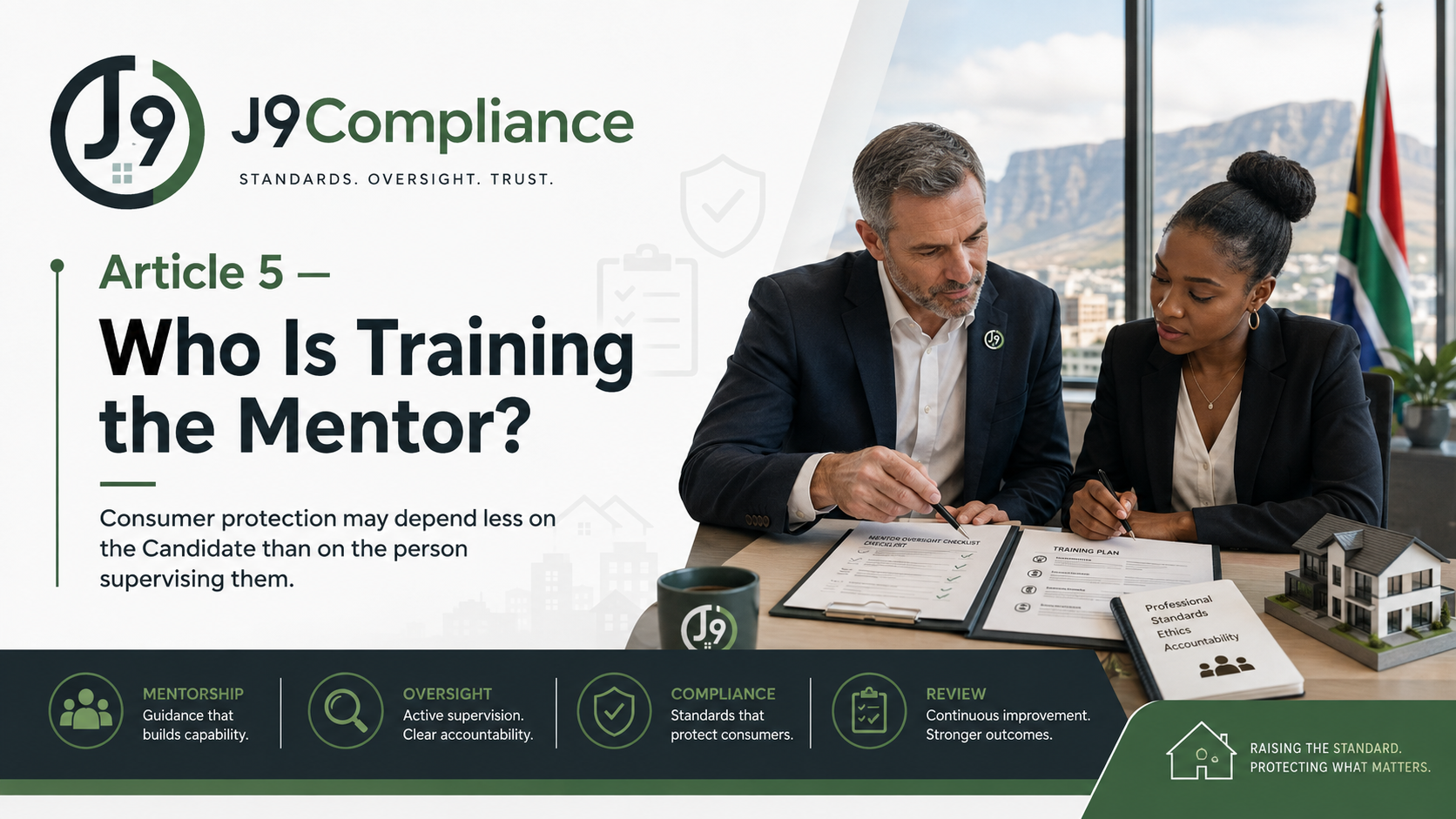
Consumer protection may depend less on the Candidate than on the person supervising them.
Article 5 - Who Is Training the Mentor?Consumer protection may depend less on the Candidate than on the person supervising them.
Why Consumer Protection Hinges on Supervision, Not Just Qualifications
One reaction to the Property Practitioners Regulatory Authority’s (PPRA) evolving qualification pathway deserves immediate scrutiny: Who protects the consumer if inexperienced practitioners enter the profession?
That is precisely the question the real estate sector ought to ask. However, the answer does not begin and end with a qualification certificate. It begins - and largely resides - within the quality of practical supervision.
Under the PPRA framework, Candidate Property Practitioners are required to act under the direct supervision of a registered practitioner who is either a Principal or a qualified property practitioner with at least six months of experience in that role. PPRA guidelines stipulate that eligible practitioners function as mentors and supervisors during this practical training period, explicitly noting that mentors must undergo a designated training programme to equip them for the role.
This provision raises critical operational questions:
Implementation & Governance: Has this mentor-training programme been fully rolled out across the sector?
Access & Providers: Who delivers the curriculum, and how is registration managed?
Verification: Is completion mandatory before the PPRA accepts a mentor’s sign-off on a candidate's logbook or portfolio of evidence?
Consistency: In the absence of a standardized, implemented mentor program, what benchmark ensures that mentorship at a boutique agency matches the rigor of a national franchise?
The Reality Gap: Nominal vs. Active Supervision
Consider two candidate practitioners under the current regulatory landscape:
CANDIDATE COMPARISON
CANDIDATE A (Active Governance) CANDIDATE B (Nominal Sign-Off)
• Weekly progress reviews • Principal listed on paper only
• Document audits & law review • Rare oversight of daily work
• Observed client interactions • Rubber-stamped sign-offs
• Verified competency before sign-off • High exposure to consumer risk
On paper, both candidates fulfil their regulatory requirement for "a mentor." In practice, their readiness to protect consumers, handle complex contracts, and navigate ethical dilemmas is vastly different.
This issue is fundamentally a systemic governance challenge, not merely an educational one.
Debates over whether the industry should retain, reform, or replace formal qualifications (such as NQF4) often miss this critical distinction:
A candidate can hold a formal qualification and still receive negligent workplace supervision.
A candidate entering through alternative competency routes can achieve high professional standard if backed by structured, rigorous mentorship.
Strengthening the GuardrailsConsumer protection relies on an interconnected ecosystem:
Qualification.
Competency Assessment.
Active Supervision.
Auditable Evidence.
Ethics.
Agency controls.
And enforcement when those controls fail.
As the PPRA carries out its mandate to regulate property practitioners, promote industry transformation, and protect consumers from undesirable practices, workplace learning becomes more critical. Expanding access to the profession must coincide with strengthening - rather than diluting - workplace standards.
To ensure consistent standards across the sector, clear benchmarks are needed:
Qualification Criteria: Defining clear prerequisites beyond six months of experience to determine who is truly qualified to mentor.
Defined Obligations: Establishing minimum required hours, documented reviews, and direct observation protocols.
Audit Trails: Requiring verifiable evidence of real-time supervision prior to final candidate approval.
Accountability: Imposing clear consequences for agencies where supervision is purely nominal.
Widening the gate into the property sector should not mean weakening the guardrails. True risk mitigation requires focusing not just on entry-level exams, but on the day-to-day oversight provided within agencies.
The following comprehensive checklist and audit schedule is designed for agency Principals and Mentors. This framework translates the principles of active supervision into actionable, day-to-day oversight, ensuring that Candidate Property Practitioners (CPPs) are genuinely competent and consumers are protected.
Part 1: The Active Supervision Checklist
Use this checklist to ensure all critical areas of a Candidate’s development are actively managed, rather than rubber-stamped.
1. Document & Contract Rigor
Mandate Review: Review and approve every Sole/Open Mandate before it is presented to the seller.
FICA & Compliance: Verify that all required FICA documents and property disclosure forms are correctly obtained and filed.
Offer to Purchase (OTP) Scrutiny: Read and cross-check every clause in an OTP drafted by the Candidate. Ensure suspensive conditions and special clauses are legally sound before any party signs.
Marketing Material: Approve all property listings, social media posts, and print ads for factual accuracy and compliance with the industry Code of Conduct.
2. Client Interaction & FieldworkValuation Shadowing:
Accompany the Candidate on at least three property valuations to observe their market analysis and presentation skills.
Show House Observation: Conduct unannounced or scheduled visits to the Candidate’s show houses to evaluate their professionalism, security protocols, and buyer engagement.
Negotiation Support: Directly supervise or listen in on contract negotiations, offering pre-negotiation strategy and post-negotiation feedback.
Conflict Resolution: Step in immediately to mediate if a Candidate encounters a complex dispute or ethical dilemma with a client.
3. Legislative & Ethical ApplicationProperty Practitioners Act (PPA):
Test the Candidate’s understanding of the PPA in practical scenarios, not just theoretical concepts.
Ethics Scenarios: Routinely pose hypothetical ethical dilemmas (e.g., undisclosed property defects, dual agency conflicts) and discuss the correct legal and moral responses.
Consumer Protection Act (CPA): Ensure the Candidate understands how the CPA applies to their marketing and contracting processes.
4. Audit Trail & Logbook ManagementRefuse Premature Sign-off:
Never sign a logbook entry or Portfolio of Evidence (PoE) task unless the Candidate has physically demonstrated the required competency.
Maintain Meeting Records: Keep brief, dated notes of every weekly 1-on-1 meeting, highlighting areas of improvement and tasks assigned.
Milestone Tracking: Monitor the Candidate's timeline to ensure they are on track to complete their practical requirements within the PPRA’s stipulated timeframe.
Part 2: Mentorship Audit Schedule
Active mentorship requires a predictable rhythm. This schedule provides a structured cadence for Principals to maintain oversight without bottlenecking the agency's daily operations.
Daily
Risk Mitigation & Deal Flow
• Approve all outbound contracts and mandates.
• Quick 5-minute daily huddle to discuss active deals or immediate challenges.
• Monitor compliance on new listings.
Weekly
Progress & Capability
• 1-on-1 Review (30-45 mins): Review the Candidate’s pipeline, lead generation, and client feedback.
• Document Audit: Check that all files for the week are complete.
• Knowledge Check: Discuss one specific piece of legislation or agency policy.
Monthly
Fieldwork & Formal Tracking
• Field Observation: Accompany the Candidate to a valuation, pitch, or show house.
•Logbook Sign-off: Review and sign off on completed PPRA logbook tasks for the month.
• Performance Appraisal: Formal feedback session on strengths and areas needing development.
Quarterly
Milestone Assessment
• Deep-dive audit of the Candidate’s Portfolio of Evidence (PoE).
• Assess readiness for final exams or professional designation assessments.
• Adjust the mentorship strategy if the Candidate is falling behind on practical competencies.Pre-SubmissionFinal Verification
• Conduct a mock interview/assessment mimicking industry standards.
• Final, comprehensive review of the entire logbook and PoE.
• Final Sign-off: Only execute the Principal's final sign-off when absolutely confident the Candidate poses zero risk to consumers.