
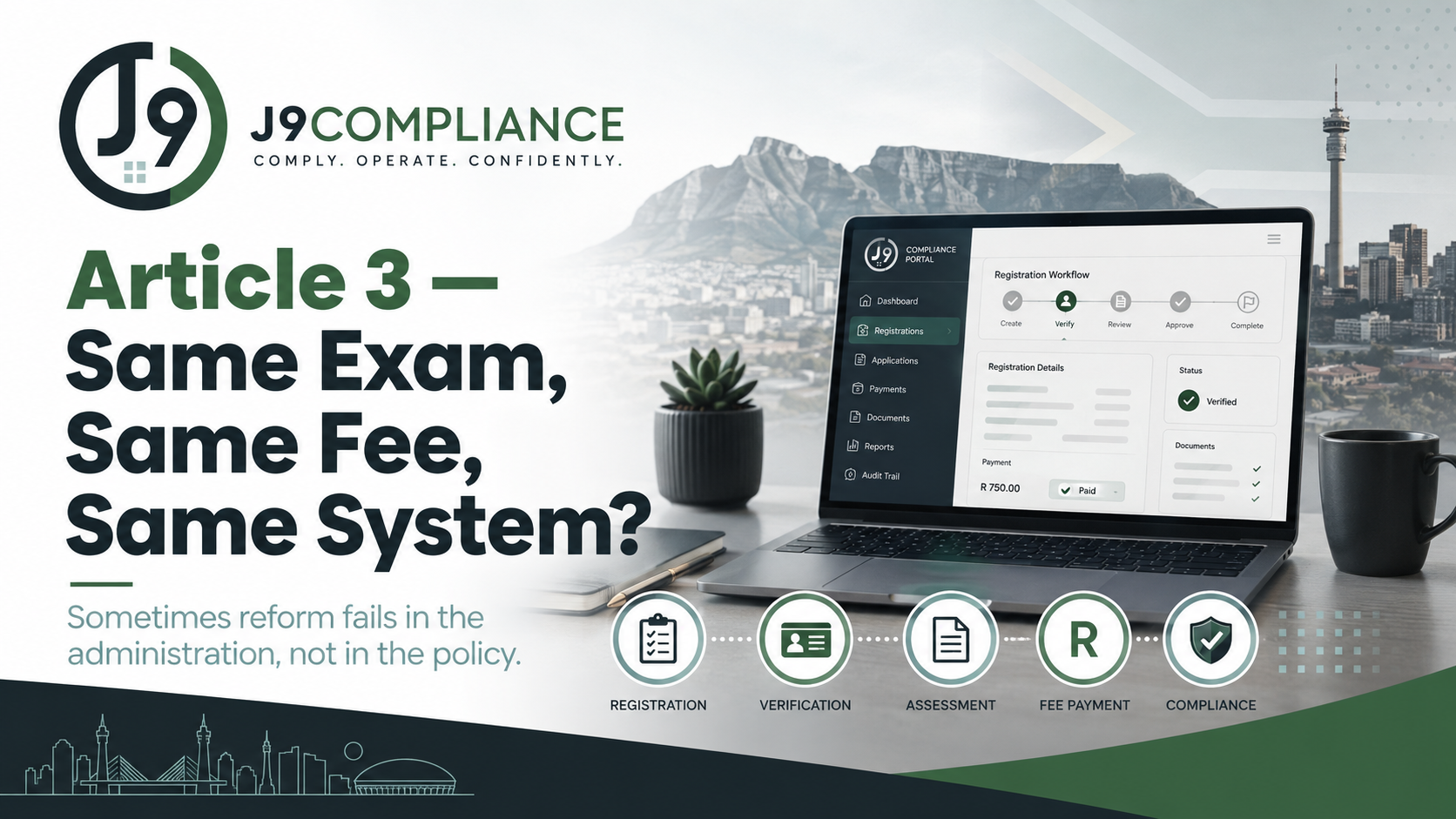
Sometimes reform fails in the administration, not in the policy.
Article 3 - Same Exam, Same Fee, Same System?
Sometimes reform fails in the administration, not in the policy.
The PPRA's July 2026 announcement created an alternative competency pathway.
The concept is relatively easy to understand.
Matric.
A PPRA Examination with the same content as PDE4.Six prescribed practical modules.
Then, subject to the regulatory requirements, registration as a Non-Principal Property Practitioner. (PPRA)
But anyone who has dealt with regulatory administration knows that a pathway does not exist merely because a policy announcement says it exists.Someone has to be able to use it.
That means very practical questions suddenly matter.
Where does the candidate register?
Which option do they select on MyPPRA?
What does the examination cost?
Does it use the existing PDE4 transaction?
Does it have a separate examination code?
Does the PPRA system record the outcome as PDE4 or something different?
What evidence must be uploaded before registration?
And how does the resulting status move through the PPRA system?
The existing PDE process is well defined: registration happens through MyPPRA, the practitioner must enrol before paying, payment is linked to the practitioner's seven-digit PPRA reference number, and a seat number follows successful enrolment and payment. (PPRA)
The existing 2026/27 calendar also lists ordinary PDE examination dates. (PPRA)
But the PPRA's competency-pathway announcement specifically said the first sittings under the new pathway would take place later in 2026, with dates to be announced. (PPRA)
That tells us the alternative examination should not simply be assumed to be administratively identical to PDE4.
Why does this matter?
Because uncertainty costs people money.
A Candidate who pays the wrong transaction, chooses the wrong examination, uploads the wrong evidence or waits months for a status correction may effectively remain stuck despite having complied with the policy.
And this is where some of the frustration expressed by practitioners about the PPRA becomes relevant.Regulation is not only about writing rules.Consumer protection also depends on administrative competence.
A regulator needs accurate records.A Principal needs to know whether a person is authorised to practise.A practitioner needs to know what is outstanding.
A consumer needs confidence that those statuses mean something.
The new pathway therefore needs more than a policy announcement.It needs a clear operating instruction.
We need PPRA to publish:
a defined examination name and code;
the prescribed fee;
the portal registration process;
required supporting evidence;
exam dates;
result classification;
and the resulting status-upgrade process.
This may sound like the least exciting question in the reform.It may actually be one of the most important.
A good policy with a broken administrative pathway is still a broken pathway.
What has your experience been: are practitioners struggling more with the actual standards - or with navigating the systems surrounding them?