
Why property compliance has to move from documentation to operating reality
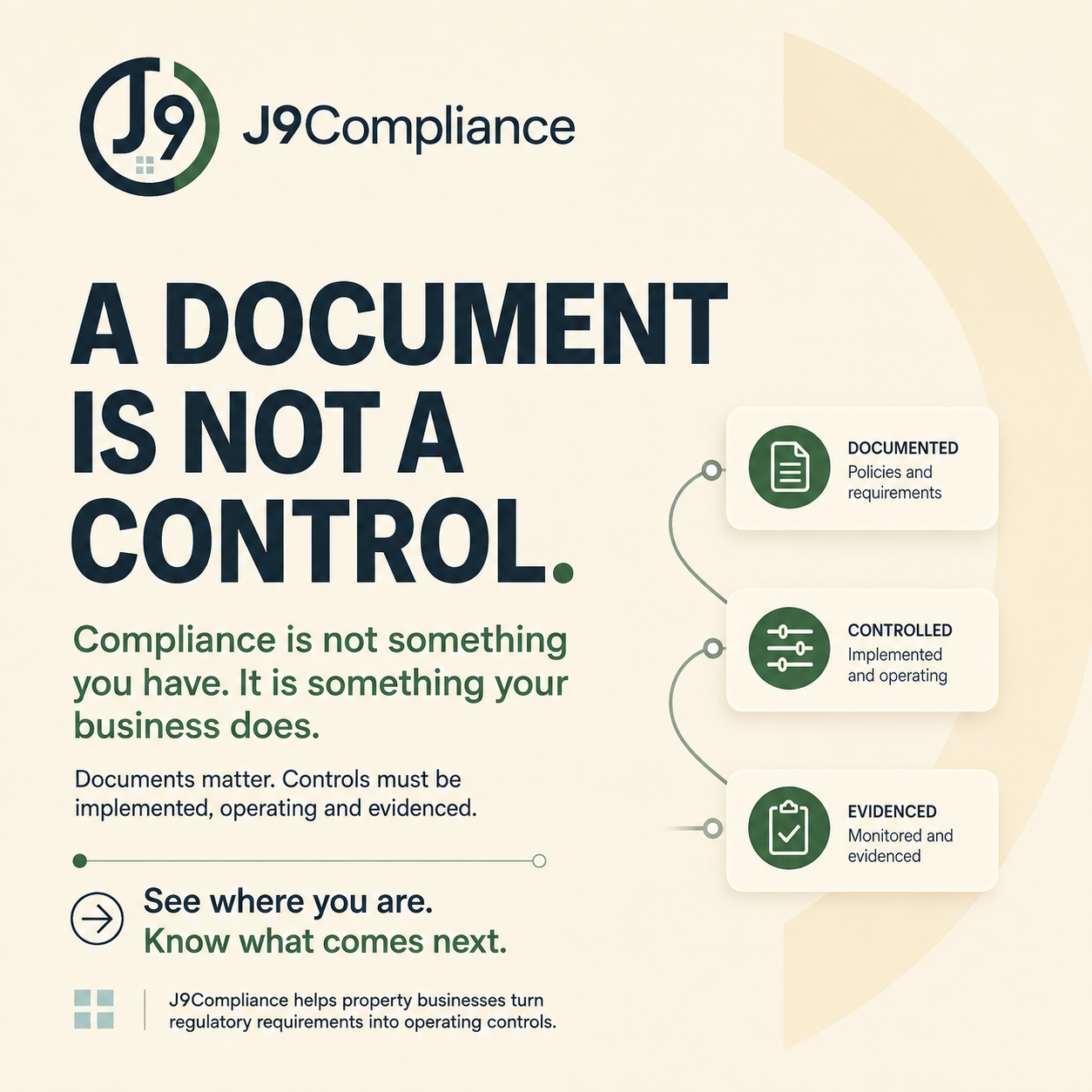
A DOCUMENT IS NOT A CONTROL
Why property compliance has to move from documentation to operating reality
Compliance is not something you have. It is something your business does.
Property businesses are surrounded by documents.
Policies. RMCPs. Registers. Certificates. Training records. Forms. Checklists. Portal submissions. Client files.
They all matter.
But having the document is not the same as having the control.
That distinction matters because two agencies can hold very similar documents and still operate very different compliance environments.
One may have clear responsibilities, consistent processes, accessible evidence and management visibility.
The other may have a file full of documents - but no reliable way to know whether the required actions are actually happening.
The difference is not the document.
The difference is control.
THE DOCUMENT TELLS US WHAT SHOULD HAPPEN
A policy can describe an expectation.
An RMCP can describe how a business intends to manage its FICA obligations.
A training record can show that training took place.
A form can capture information.
A register can record an event.
These are important parts of a compliance environment. But none of them, standing alone, proves that the underlying process is consistently operating.
A document may describe the control.
It is not, by itself, the control.
The practical question is what happens after the document exists.
Who is responsible?
What action must happen?
When must it happen?
What evidence should be created?
What happens if something is missing, late, incorrect or escalated?
How does management know?
That is where compliance moves from documentation into operating reality.
DOCUMENTED. CONTROLLED. EVIDENCED.
A useful way to think about the difference is in three layers.
DOCUMENTED
The requirement, policy, procedure or expectation is recorded and understood.
CONTROLLED
The requirement has been translated into something the business actually does: responsibility is clear, the process is workable, and the action takes place where the work happens.
EVIDENCED
The business can demonstrate what happened, identify exceptions and retain enough information for management to see whether the process is working.
The three layers belong together.
Documentation without operation becomes a filing exercise.
Operation without evidence becomes difficult to demonstrate.
Evidence without a clear control can become administration without purpose.
The goal is not more paperwork.
The goal is a working system.
WHAT CHANGES WHEN YOU THINK IN CONTROLS?
The question changes from:
“Do we have an RMCP?”
to:
“Does our RMCP describe the business we actually operate, and are the responsibilities and processes it describes happening in practice?”
It changes from:
“Did the practitioner sign the training register?”
to:
“Does the practitioner understand what applies to their role, what they must do, and what evidence is expected?”
It changes from:
“Is the client file complete?”
to:
“Did the required process happen, is the evidence present, and does someone know what to do when it is not?”
And it changes from:
“Where is the compliance file?”
to:
“Can management see what is working, what is missing and what needs attention?”
That is a very different management conversation.
THE PRINCIPAL TEST
For a Principal, owner or franchisee, compliance should eventually become visible through a handful of practical questions:
What applies to this business?
Who owns the response?
What must actually happen?
What proves that it happened?
What needs attention now?
If those questions cannot be answered without searching through emails, folders, spreadsheets and individual staff memories, the business may have documentation without enough control visibility.
This is not about criticising documents.
Documents are necessary.
The issue is expecting them to do a job they cannot do on their own.
A policy cannot supervise a practitioner.
An RMCP cannot check whether a process was followed.
A training certificate cannot tell management whether the learning is being applied.
A checklist cannot correct an exception.
A register cannot decide what happens next.
People, processes, responsibilities, evidence and management action make the control environment work.
COMPLIANCE LIVES WHERE THE WORK HAPPENS
One of the reasons compliance becomes burdensome is that it is often treated as a separate administrative layer.
The business does the work.
Then someone tries to “do compliance” around the work.
That usually creates duplication.
The stronger approach is to connect the obligation to the operating process itself.
When a practitioner is onboarded, the compliance responsibilities relevant to that role should form part of onboarding.
When a client file is opened, the required steps should form part of the file process.
When evidence is created, it should be stored where it can be found and reviewed.
When something is missing or goes wrong, the business should know who must act.
When requirements change, someone should be responsible for deciding what changes in the business.
Compliance becomes easier to manage when it is built into the way the business actually operates.
That is what we mean by operating controls.
THIS IS ALSO A MANAGEMENT ISSUE
Compliance is often discussed as though its only purpose is to satisfy a regulator.
Regulatory obligations are obviously important.
But an operating control environment also gives management something valuable: visibility.
A Principal should not need to personally inspect every practitioner file, every training record and every client transaction to know whether the business is under control.
Management needs a way to see the exceptions.
What has expired?
What is incomplete?
What has not been acknowledged?
What requires escalation?
What corrective action is still open?
What changed?
That is the movement from compliance administration to compliance control.
Not because every risk disappears.
Not because a system can guarantee compliance.
But because responsibility, action and evidence become more visible and manageable.
THE REGULATOR SETS THE OBLIGATION. YOUR BUSINESS OWNS THE RESPONSE.
J9Compliance is not built around the idea that a consultant can “make” an agency compliant.
Management responsibility remains with the business.
Our role is different.
We help property businesses understand what applies, see where exposure sits, organise responsibility, build practical controls, retain evidence and create better management visibility.
Requirement → Process → Person → Control → Evidence.
The obligation may come from legislation, a regulator, a directive, a professional requirement or an internal policy.
But somebody inside the business still has to turn that obligation into operating reality.
SEE WHERE YOU ARE. KNOW WHAT COMES NEXT.
Not every agency starts in the same place.
One agency may have strong documentation but weak evidence.
Another may have good people and processes but inconsistent records.
Another may have grown quickly and lost visibility across practitioners, files or offices.
That is why the first step is not always “buy another document”.
The first step is to see where you are.
J9Compliance uses a simple public pathway:
KNOW → SEE → ORGANISE → BUILD → PROVE → WATCH → IMPROVE
Know what applies.See where the exposure sits.Organise responsibility and priorities.Build the controls into the business.Prove they are operating.Watch for change, exceptions and drift.Improve what is not working.
A document can be an important part of that pathway.
But the destination is not a better filing cabinet.
The destination is control.
A DOCUMENT IS NOT A CONTROL.
Compliance is not something you have. It is something your business does.
If you are a Principal, owner or franchisee and you are not sure where your agency’s exposure sits, start by seeing where your agency stands.
Agency Compliance Exposure Mapj9web.co.za/agency_map/
The Agency Compliance Exposure Map is a practical exposure review and prioritisation tool. It is not a regulatory audit and does not, by itself, make an agency compliant.