

Submitted Your 2026 RCR? That Does Not Mean Your RMCP Is Compliant
Many estate agencies are currently operating under a risky assumption: “I submitted my FIC return in July, so I’m up to date.”
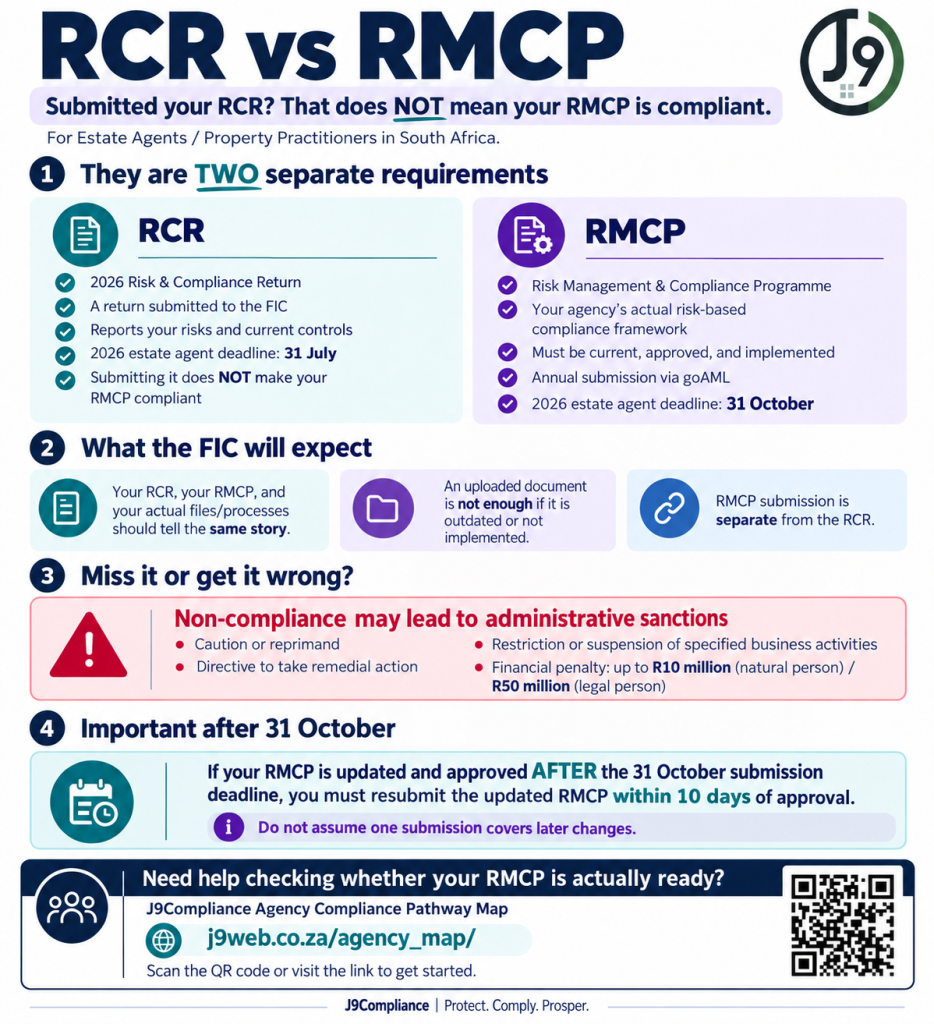
While understandable, this is a massive compliance misunderstanding. Your 2026 Risk and Compliance Return (RCR) and your Risk Management and Compliance Programme (RMCP) are completely separate legal obligations. Submitting your RCR in July fulfilled one requirement, but it did not automatically make your RMCP compliant, and it does not excuse you from the urgent deadline approaching this month.
RCR vs. RMCP: Understand the Difference
The simplest way to view the difference is this: your RCR is a regulatory return, while your RMCP is your operating framework.
The RCR was a snapshot. It asked you to tell the Financial Intelligence Centre (FIC) about your exposure to money laundering and terrorist financing, and the controls you claim to have in place.
The RMCP is the actual engine. It is the comprehensive, customized document detailing exactly how your specific agency identifies, monitors, and manages those risks in practice every single day.
You could have successfully submitted your RCR in July, but still have an RMCP that is dangerously outdated, completely generic, lacking formal approval, or entirely ignored by your actual agents. Submission of one does not fix the deficiencies in the other.
The Alignment Trap
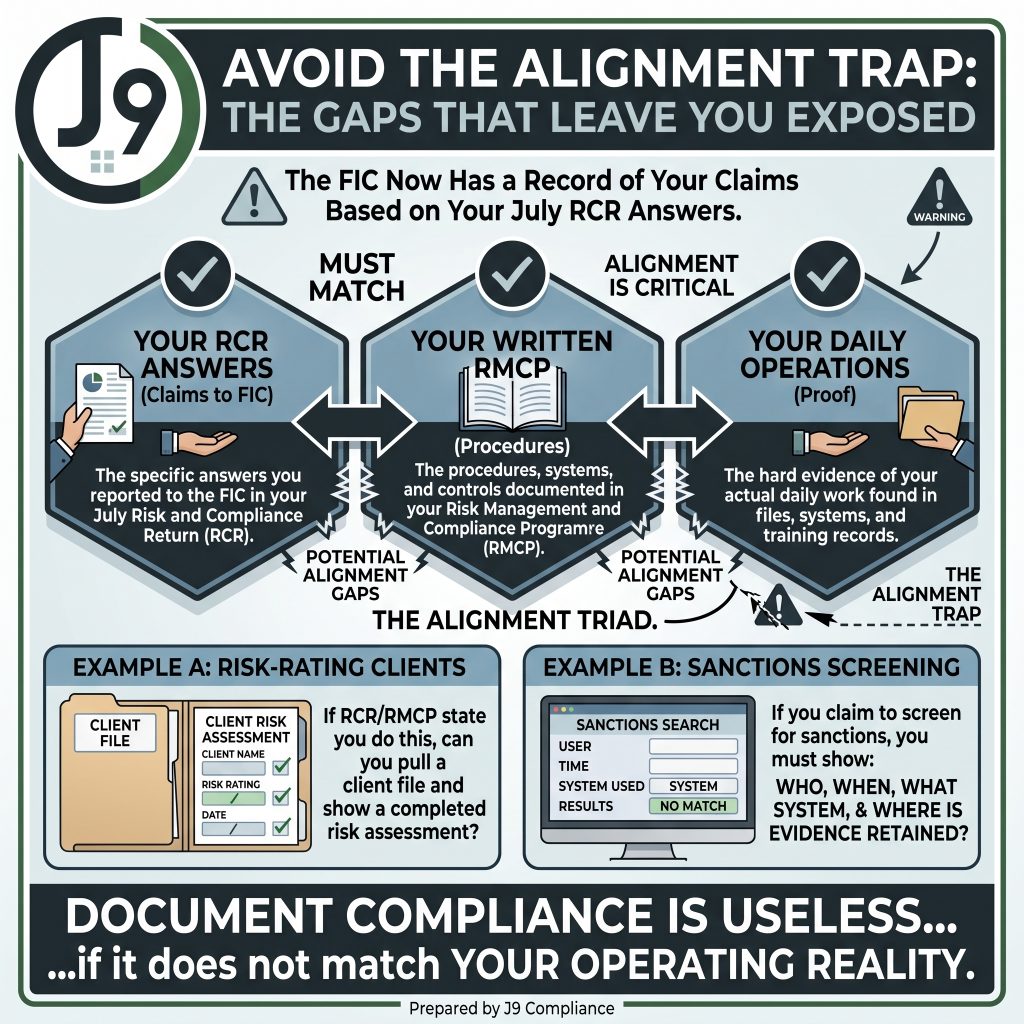
Because you answered specific questions in your July RCR, the FIC now has a record of how you claim to operate. This makes your RMCP even more critical. There must be a flawless, logical match between three things:
What you reported to the FIC in your RCR.
What your written RMCP says you do.
What you can actually prove in your daily operations.
If your RCR and RMCP state that you risk-rate your clients, you must be able to pull a client file and show the actual risk assessment. If you claim to screen for targeted financial sanctions, you need to show who does it, when they do it, and where the evidence is kept. Document compliance is useless if it does not match your operating reality.
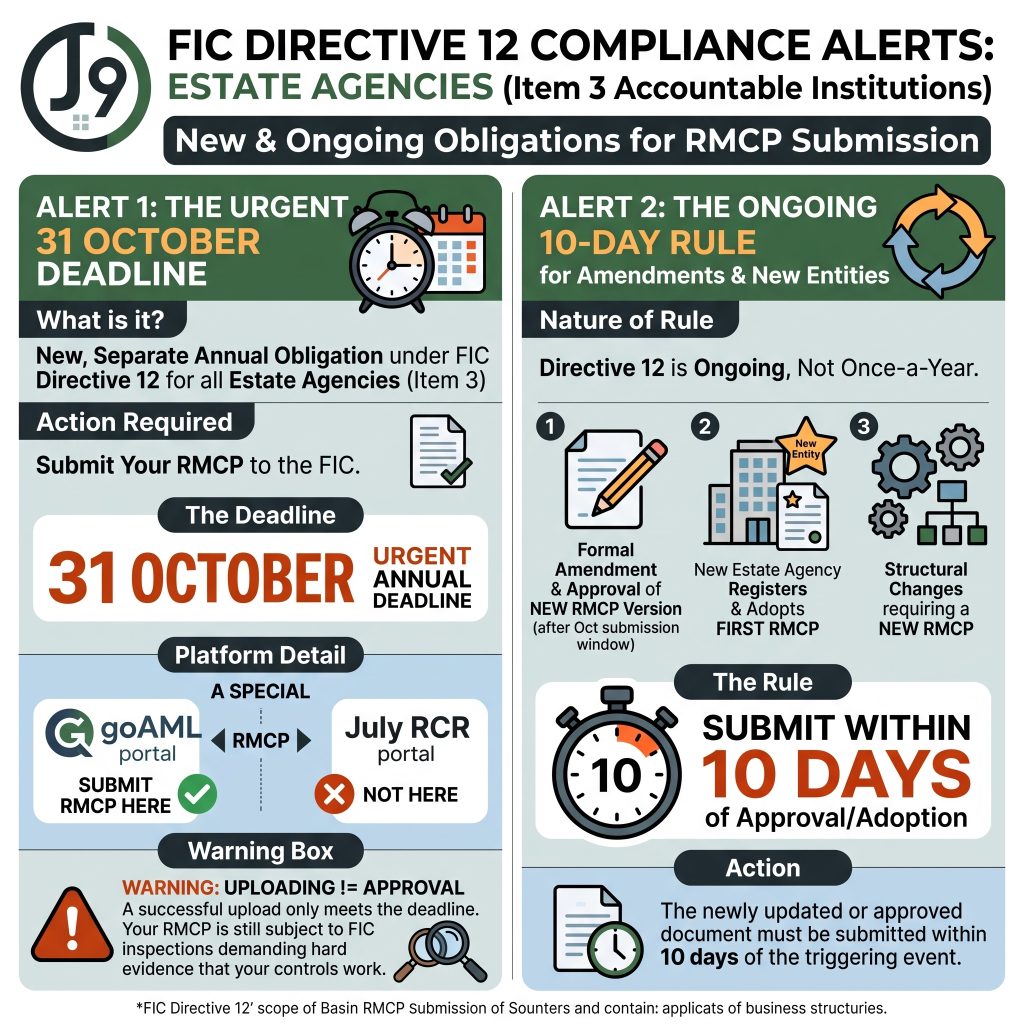
The Urgent 31 October Deadline This distinction is urgent because FIC Directive 12 has introduced a brand new, separate annual obligation. Beginning this year, estate agencies (classified as Item 3 accountable institutions) must submit a copy of their RMCP to the FIC by 31 October.
This submission also happens on an entirely different platform. The July RCR used a dedicated portal, but your RMCP must be submitted through goAML.
Furthermore, do not fall into the trap of thinking that successfully uploading your RMCP means the FIC has “approved” it. A successful upload simply means you met the submission deadline. Your RMCP is still subject to FIC inspections, which are increasingly focused on demanding hard evidence that your controls actually work.
The Ongoing 10-Day Rule for Amendments and New Entities
Compliance with Directive 12 is not a “once a year and forget it” exercise. The FIC has built-in a strict ongoing requirement for any updates made outside of the annual window.
If your agency formally amends and approves a new version of its RMCP after the annual October submission period, Directive 12 requires you to submit that newly updated RMCP to the FIC within 10 days of its approval.
This 10-day rule also applies to new entities. If a newly established estate agency registers with the FIC and officially adopts its first RMCP, or an existing agency makes structural changes requiring a brand new RMCP, the approved document must be submitted within 10 days.
The Real Cost of Non-Compliance: What’s Actually at Stake?
If you search the FIC Act for penalties under Section 45C, you will see astronomical statutory numbers-up to R10 million for natural persons and R50 million for companies. While those theoretical caps exist on paper to penalize major international banks and deliberate money-laundering syndicates, they do not reflect the day-to-day enforcement reality for estate agencies.
In the real property sector, the FIC applies the legal principle of proportionality. The regulator assesses the size of the firm, whether the breach was deliberate, and the actual risk posed to the financial system.
Here is what the penalty landscape actually looks like for estate agents:
The Baseline Fine (Around R25,000): In practice, minor or first-time administrative breaches – such as failing to submit a required return or missing a directive upload deadline – typically attract baseline financial sanctions starting around R25,000. While this won’t put an agency out of business, handing over R25,000 in hard-earned commission for an administrative oversight is completely unnecessary bottom-line damage.
The Regulatory Radar: A R25,000 penalty is not just a fine; it serves as a formal sanction that places your business directly onto the FIC’s targeted inspection list.
When Fines Escalate: There is a fundamental difference between a late submission error (Directive 12) and failing to implement an RMCP altogether (Section 42). If an inspection reveals that an agency has no real RMCP, never risk-rates clients, or fails to screen against sanctions lists, the FIC views that as an active threat to the market. Penalties quickly scale into the hundreds of thousands of rands, accompanied by public reprimands and binding directives that disrupt daily trading.
You do not need to lose sleep over multi-million rand headline figures, but you should not donate R25,000 or invite regulatory scrutiny over a missed October deadline or an outdated document. Ensure your agency is reviewed, signed off, and submitted before the window closes
The Required Sequence Before You Submit
Before the 31 October deadline, do not just ask, “Do we have a PDF we can upload?” Instead, follow this mandatory sequence:
Review: Confirm the document accurately reflects your current business, risks, and processes.
Approve: Ensure the highest authority in your agency has formally signed off on it.
Implement: Verify that your staff actually understand and use the controls.
Retain Evidence: Ensure your client files and systems prove the work is being done.
Submit: Upload the finalized, approved RMCP through goAML.
The 2026 RCR deadline has passed, but the RMCP deadline is imminent. If the FIC looked at your July RCR answers, read your RMCP, and audited your daily client files, would all three tell the exact same story?
Make sure your RMCP actually supports what you said. https://j9web.co.za/agency_map/
J9Compliance
Protect | Comply | Prosper
General compliance information only; not legal advice.