
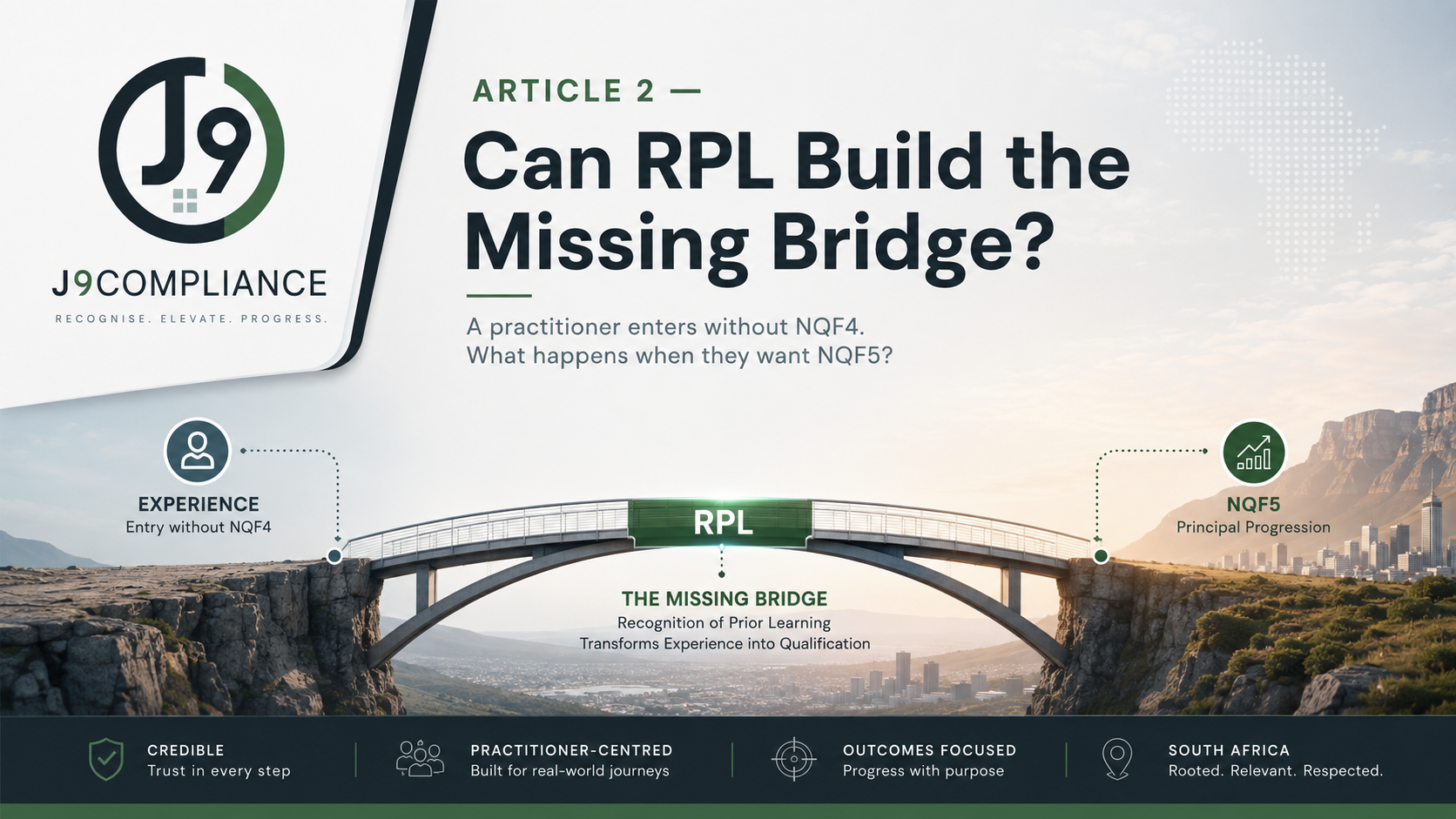
A practitioner enters without NQF4. What happens when they want NQF5?
Article 2 - Can RPL Build the Missing Bridge?
A practitioner enters without NQF4. What happens when they want NQF5?
The new competency pathway creates a fascinating distinction in the property profession.A person can now potentially become a registered Non-Principal Property Practitioner without first obtaining the formal NQF4 real-estate qualification.But the formal qualification for becoming a Principal sits at NQF Level 5.
And the normal entry requirement for the Higher Occupational Certificate: Principal Real Estate Agent, SAQA ID 121691, is the Occupational Certificate: Real Estate Agent at NQF4. (SAQA)
At first glance that looks like a dead end.
It isn't necessarily.Because the same SAQA qualification expressly allows Recognition of Prior Learning - RPL - for access.
That means an accredited institution, skills-development provider or accredited workplace can assess someone's prior learning and potentially admit that person to the NQF5 programme even where they do not hold the normal NQF4 prerequisite. (SAQA)
That could create an elegant bridge.A practitioner might enter the profession through the competency route, build several years of real workplace experience, undergo a proper RPL assessment and then gain access to the Principal qualification.Importantly, RPL does not mean:
“You worked for ten years, therefore you automatically get a qualification.”
That would undermine the very standards we are trying to protect.RPL means:
“You have acquired learning outside the traditional classroom. Show us what you know and can do, and we will assess it against an established standard.”
That is a very different proposition.
And it may be particularly relevant in South Africa.
There are capable adults whose education was interrupted by circumstances that had very little to do with intelligence, capability or work ethic.
There are people managing staff, budgets, customers, negotiations and businesses who may not have followed a conventional education pathway.The question should perhaps not be whether we pretend those experiences are qualifications.We shouldn't.
The question should be whether those experiences give someone the right to be assessed for access to further learning.SAQA's current NQF5 qualification already seems to recognise that principle through its RPL provisions. (SAQA)
The unresolved property-sector question is what happens next at the PPRA.If a competency-route practitioner:
passes the PPRA Examination,
becomes a Non-Principal,
gains RPL access to NQF5,
and then successfully completes the formal Principal qualification,
will the PPRA recognise that complete sequence for progression to PDE5 and Principal registration?
That is the bridge we need clarified.
This is not about lowering the standard.If anything, a properly assessed RPL pathway can be more intellectually honest than using a certificate as a proxy for competence without examining what somebody can actually do.
Perhaps our principle should be:
Do not give somebody competence because they have experience.
Give them the opportunity to prove competence because they have experience.
Those are very different things.
Should demonstrated workplace learning be allowed to open the next educational gate - provided the person still has to prove the required competence?
https://www.linkedin.com/pulse/practitioner-enters-without-nqf4-what-happens-when-want-szeles-nk6tf/